One advantage that the offense has over the defense in passing is that the quarterback knows ahead of time where the receiver is going to run. This way the quarterback can throw the ball to the spot before the receiver is there. Timing and practice between the quarterback and the receiver is important and a key to success in the passing game. What is a passing route? Each play requires that the receiver run a specific pattern or route. The route includes both the distance and the direction that the receiver should run. For example, the receiver may run 10 yards up the field and then turn to the sidelines. Here is a list of some standard football pass routes: Hook or Hitch Route
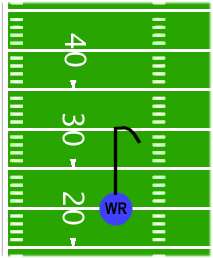
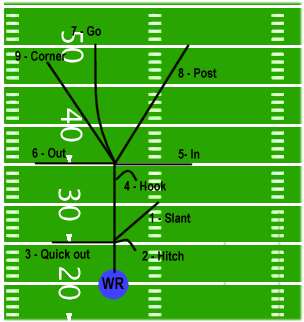
![]() In the hook or hitch route the receiver runs up the field a certain distance and then quickly stops and turns back to the quarterback to catch the ball. The receiver makes a slight hook pattern moving back in the direction of the quarterback. The hitch generally refers to a short route of around 5 yards while the hook is a longer route of 10 to 12 yards. Slant Route
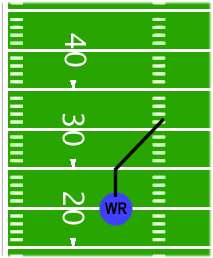
![]() In the slant route the receiver goes a short distance down the field and then quickly cuts at a 45 degree angle across the middle of the field. This is a great route against blitz defenses or where a quick pass is needed. Out Route
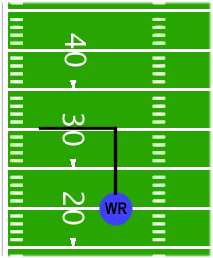
![]() An out route is where the receiver runs straight down the field for a certain distance and then runs "out" directly towards the sideline. A normal out will go for 10-15 yards down field before turning toward the sidelines. A "quick" out is a short out of around 5 yards. In or Dig Route
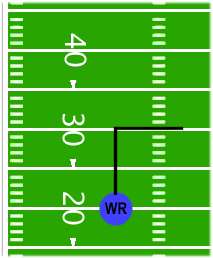
![]() The In route or dig route is similar to the out, but where the receiver cuts at a 90 degree angle to the middle of the field. Post Route
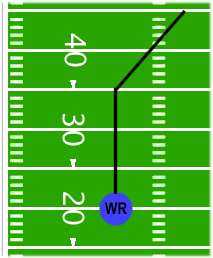
![]() Post routes are used for long pass plays. In a post route the receiver runs 10 to 15 yards straight downfield and then cuts in at an angle toward the goal posts. Go - A go route is usually a straight route up the field where the receiver uses their speed to pass the cornerback. Sometimes they may make an earlier move as if to run an out or in route to fake out the defender. Then they put on a burst of speed and run a go route. Corner or Flag - Similar to the post route, the flag route is usually run on longer plays. In the flag route the receiver runs 10-15 yards up the field and then turns toward the pylon of the corner of the end zone. Route Trees
![]() Route trees show all the different routes a receiver can run in a single picture. They are generally numbered so that the receiver knows which route is a "1" and which route is "7". This makes calling plays quicker and easier. Option Reads In the NFL many teams use option reads. This is where the receiver can run a different route depending on the defense. For example, if they were to run an "in" route, but they see the defense is set up to defend the "in", the next option may be to run an "out". Of course, this takes practice and study. Both the quarterback and the receiver need to recognize that they are moving to the option route, otherwise the quarterback could throw an interception. More Football Links: Back to Football Back to Sports for Kids |
|