|
Ancient China
Back to History for Kids
Ancient China was one of the oldest and longest lasting civilizations in the history of the world. The history of Ancient China can be traced back over 4,000 years. Located on the eastern part of the continent of Asia, today China is the largest country in the world.
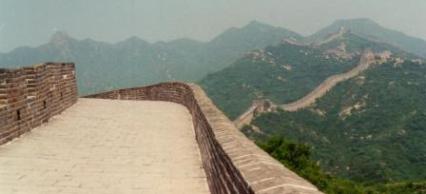
The Great Wall of China
Dynasties
Throughout most of China's history it was ruled by powerful families called dynasties. The first dynasty was the Shang and the last was the Qing.
Empire
Ancient China also boasts the longest lasting empire in history. It began with the Qin dynasty and the first emperor Qin who united all of China under one rule in 221 BC. Emperors would continue to rule over China for more than 2000 years.
Government
In early times the lands were ruled by the feudal system where lords owned the lands and peasant farmers worked the lands for them. In later years, the empire was run by civil service officials who ran the cities, collected taxes, and enforced the laws. Men had to pass exams to become officials.
Art, Culture, and Religion
Art, culture, and religion were often tied together. There were three main religions or philosophies including Taoism, Confucianism, and Buddhism. These ideas, called "the three ways" had a large impact on the way people lived as well as their art. Art focused on "the three perfections"; painting, poetry, and calligraphy.
Mongols
The great enemy of the Chinese was the Mongols who lived to the north. They even built a wall thousands of miles long to try and keep the Mongols from invading. The Mongols did conquer China for a time, however, and established their own dynasty called the Yuan Dynasty.
Fun Facts about Ancient China
- The Last Emperor of China, Puyi, became ruler when he was only 3 years old.
- The Chinese have used chopsticks to eat for over 4,000 years.
- After inventing the printing press, the most popular type of booklet was Buddhist sayings and prayers.
- The Art of War is a famous book on battle strategy written by military strategist Sun Tzu during the Spring and Autumn Period. Even though it is over 2500 years old, it is often quoted today.
- Two major rivers played a role in Ancient China: the Yellow River and the Yangtze River. The Yangtze is the third longest river in the world and the Yellow the sixth.
- In China the dragon is a symbol of good luck, power, and strength. The dragon was often the symbol of the Emperor.
- Scholars that served as officials were the most respected class in the land. Right after them were peasant farmers who were respected because they supplied the country with food.
- The Ancient Chinese were the first people to drink tea. At first it was primarily used for medicine.
- Although many people spoke different types of Chinese, the written language was the same making reading and writing very important to the Empire.
- The biggest festival of the year was the New Year celebration. Everyone took time off and celebrated during this time.
- According to legend, silk was discovered in the emperor's garden in 2700 BC by Hsi-Ling-Shi, the wife of Emperor Huang-Ti.
For more information:
For more reading and reference see these books:
You are in Ancient China by Ivan Minnis. 2005.
Exploring Ancient China by Elaine Landau. 2005.
Eyewitness Books: Ancient China by Arthur Cotterell. 2005.
See also China at Encyclopedia Junior.
Back to History for Kids
|
|
Kid's Poll |
|
Where would you like to go for Spring Break this year?
|
|
Joke of the Day |
Q: What did the judge say when the skunk walked in the court room?
A: Odor in the court!
|
|
Today In History |
|
Who was born on this day: 1732 George Washington (1st US President) 1820 Frederic Chopin (Classic Composer) What happened today in history:
1876 Johns Hopkins University is founded 1980 The "Miracle on Ice": US defeats Russia in Hockey
|
|