|
Ancient Greece
Ancient Greece was a civilization that ruled much Europe many thousands of years ago. The Greeks came before the Romans and much of the Roman's culture was copied from the Greeks.
Ancient Greece formed the foundation of much of Western culture today. Everything from government, philosophy, science, mathematics, art, literature, and even sports was impacted by the Ancient Greeks.
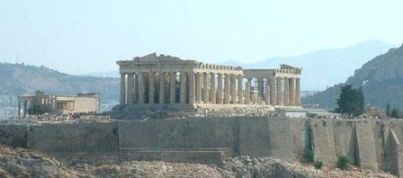
Acropolis in Athens
Periods
Historians often divide up the history of Ancient Greece into three periods:
- Archaic Period - This period ran from the start of Greek civilization in 800 BC to the introduction of Democracy in 508BC. This period included the start of the Olympic Games and Homer's writing of the Odyssey and the Illiad.
- Classical Period - This is the time that most of us think of when we think of Ancient Greece. Athens was governed by a democracy and great philosophers like Socrates and Plato arose. Also, the wars between Sparta and Athens were during this time. This period ended with the rise and then death of Alexander the Great in 323 BC.
- Hellenistic Period - The Hellenistic period lasted from the death of Alexander the Great until 146 BC when Rome conquered Greece. The name Hellenistic comes from the Greek work "hellens" which is just what they called themselves.
Athens and Sparta
Athens and Sparta were the two main city states that ruled much of ancient Greece. They were often rivals and fought each other in the Peloponnesian Wars. Many times they were united together to protect the Greek lands. The culture of the two cities was very different. Sparta was almost entirely focused on war and how to fight, while Athens focused on the arts and learning.
Fun Facts about Ancient Greece
- They ate dinner while lying on their sides.
- They invented the yo-yo which is considered the 2nd oldest toy in the world after the doll.
- About one third of the population of some city-states were slaves.
- There were more city-states than just Sparta and Athens, Ancient Greece had around 100 city-states.
- The Romans copied much of the Greek culture including their gods, architecture, language, and even how they ate!
- Pheidippides was a Greek hero who ran 150 miles from Marathon to Sparta to get help against the Persians. After the Greeks won the war, he ran 25 miles from Marathon to Athens to announce the victory. This is where the marathon running race gets its name.
- When law trials were held in the city of Athens, they used large juries of 500 citizens. That's a lot more than the 12 we use today.
Recommended books and references:
A guide to the golden age of Greece by Julie Ferris. 1999.
A Cultural Atlas for Young People: Ancient Greece by Anton Powell. 1989.
Eyewitness Books: Ancient Greece written by Anne Pearson. 2004.
Life in ancient Athens by Don Nardo. 2000.
Kids, learn more about the Ancient Greek Civilization here:
See also the Ancient Greece at Encyclopedia Junior.
Back to History for Kids
|
|
Kid's Poll |
|
Where would you like to go for Spring Break this year?
|
|
Joke of the Day |
Q: What did the judge say when the skunk walked in the court room?
A: Odor in the court!
|
|
Today In History |
|
Who was born on this day: 1732 George Washington (1st US President) 1820 Frederic Chopin (Classic Composer) What happened today in history:
1876 Johns Hopkins University is founded 1980 The "Miracle on Ice": US defeats Russia in Hockey
|
|