Sports Study Music Kids Site and Search Games Movies Fun Kids

Kids Sports

Football: Offense Basics

Kids Sports >> Football >> Football Strategy

Football offense


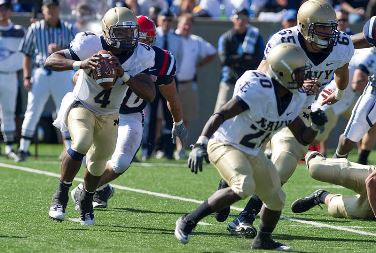
The team that has the ball in football is the offense. They have four downs to go ten yards and get a first down or they lose possession of the ball. The offense can advance the ball by running or passing it.

Just like on defense there are eleven players on the field for each offensive play. The exact positions will change on different plays, but generally the offensive positions are:
  • 1x Center
  • 2x Tackle
  • 2x Guard
  • 1x Tight End
  • 1x Tail Back
  • 1x Fullback
  • 1x Quarterback
  • 2x Wide Receivers
Lining Up on the Line of Scrimmage

To start out the play the team must line up on the line of scrimmage. You have to have at least seven players on the line of scrimmage. All the players but one must be set when the ball is snapped. One of the backfield players may be "in motion" at the time of the snap.

The Play Starts with the Snap

Each offensive play begins when the center snaps the ball to the quarterback.

Blocking

An important part of any offensive play is blocking. This is where offensive players get in the way of defensive players to prevent them from tackling the player with the ball. Blockers may not hold onto defensive players making this a difficult task.

In the NFL blocking schemes are complex. Players have specific assignments on each play. The full back may be responsible for blocking the middle linebacker to the left. The right guard may pull and block the left defensive end to the right. It looks like a mess on TV, but each player has a job to do. Even the receivers have blocking responsibilities on running plays. A good block by a receiver on a cornerback can make the difference in scoring a touchdown.

Running Plays

On running plays the quarterback may run with the ball or hand it off to a running back. On rare occasions a receiver may sprint through the backfield and receive the ball for a running play.
  • Up the middle - Running plays may be designed to go through a hole created in the defensive line. In this case the running back will try to dart through the hole when it opens up. Sometimes he may follow the fullback through the hole where the fullback is to block the linebacker out of the way.
  • Sweep - The sweep running play is designed to try and run around the outside of the defensive line.
  • Draw - A draw running play is when the quarterback moves back as if to pass the ball and then hands the ball off to a running back.
Passing Plays

In a passing play the quarterback drops back and throws the ball to an eligible receiver. Typically there is a primary receiver for a play, but if that is covered, the quarterback will look to other receivers. Players that catch the ball include wide receivers, slot receivers, tight ends, and running backs.

Some examples of passing plays include:
  • Down the field - Longer passes down the field where the receiver runs fast routes such as go, fade, and post routes. The quarterback needs more time from his offensive line for this play to develop.
  • Short pass - Short passes don't gain as much initial yardage, but are very helpful when the defense blitzes or the offensive line is having trouble blocking. Typical short pass routes include the slant, hook, and the out.
  • Fade - The fade route is often run when the offense is close to the goal line. A big tall receiver will run to the corner of the end zone and the quarterback will throw the ball high in the air. The hope is that the tall receiver can out jump the cornerback for the ball.
  • Screen Pass - A screen pass is a short pass in the backfield. Typically the offensive linemen will let the defensive linemen get by them. Then the quarterback will toss the ball just over the defensive linemen to a running back. Now the offensive linemen can move down the field and block the linebackers for the running back.
Play Action

Play action is where the quarterback fakes a handoff for a run and then passes the ball. This is very effective when the team has had success running. The fake will cause the linebackers and safeties to "bite" on the run and move towards the line of scrimmage. This can give the receivers an advantage in getting open for the pass.

More Football Links:

Rules
Football Rules
Football Scoring
Timing and the Clock
The Football Down
The Field
Equipment
Referee Signals
Football Officials
Violations that Occur Pre-Snap
Violations During Play
Rules for Player Safety
Positions
Player Positions
Quarterback
Running Back
Receivers
Offensive Line
Defensive Line
Linebackers
The Secondary
Kickers
Strategy
Football Strategy
Offense Basics
Offensive Formations
Passing Routes
Defense Basics
Defensive Formations
Special Teams

How to...
Catching a Football
Throwing a Football
Blocking
Tackling
How to Punt a Football
How to Kick a Field Goal

Biographies
Peyton Manning
Tom Brady
Jerry Rice
Adrian Peterson
Drew Brees
Brian Urlacher

Other
Football Glossary
National Football League NFL
List of NFL Teams
College Football for Kids

Back to Football

Back to Sports for Kids

Kid's Poll

Which of these cities would you most like to visit on vacation?
New York City
Paris
London
Tokyo
Rome


Vote on more Kids Polls!


Joke of the Day

Q: Knock, knock----Who's There?----Ashe----Ashe who?

A: Bless you!


Today In History

Who was born on this day:
1952 Mr. T (Actor)
1981 Josh Hamilton (Baseball player)

What happened today in history:
1881 The American Red Cross is established by Clara Barton.
1927 Charles Lindbergh completes the first solo nonstop flight across the Atlantic Ocean.