Geography >> Europe >> Sweden History and Timeline
Sweden
Capital: Stockholm
Population: 10,036,379
The Geography of Sweden
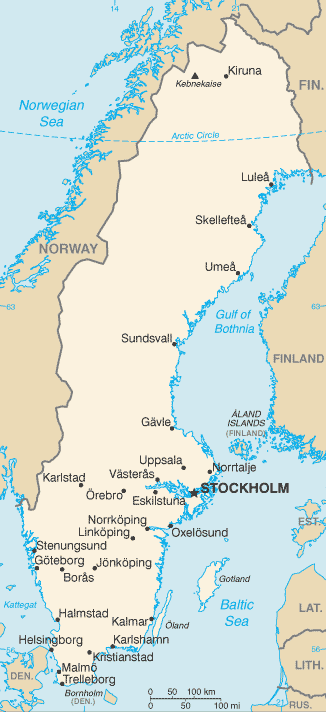
Borders: Norway, Finland, maritime (water) borders with Denmark, Germany, Poland, Russia, Lithuania, Latvia, and Estonia. Sweden is also connected to Denmark by the Oresund Bridge.
Total Size: 449,964 square km
Size Comparison: slightly larger than California
Geographical Coordinates: 62 00 N, 15 00 E
World Region or Continent: Europe
General Terrain: mostly flat or gently rolling lowlands; mountains in west
Geographical Low Point: reclaimed bay of Lake Hammarsjon, near Kristianstad -2.41 m
Geographical High Point: Kebnekaise 2,111 m
Climate: temperate in south with cold, cloudy winters and cool, partly cloudy summers; subarctic in north
Major Cities: STOCKHOLM (capital) 1.279 million (2009), Gothenburg, Malmo
Major Landforms: Scandinavian Mountains, Gotland Island, Oland Island, Norrland region, Svealand region, Gotaland region
Major Bodies of Water: Lake Vanern, Lake Vattern, Lake Siljan, Angerman River, Eman River, Indal River, Hano Bay, Gulf of Bothnia, Sea of Bothnia, Baltic Sea
Famous Places: Stockholm Palace, Ice Hotel, Kosterhavet National Park, Marstrand, Borgholm Castle, Drottningholm Palace, Gamla stan in Stockholm, Kalmar Castle, Vasa Museum, Oresund Bridge, Djurgarden, Nobel Museum
Economy of Sweden
Major Industries: iron and steel, precision equipment (bearings, radio and telephone parts, armaments), wood pulp and paper products, processed foods, motor vehicles
Agricultural Products: barley, wheat, sugar beets; meat, milk
Natural Resources: iron ore, copper, lead, zinc, gold, silver, tungsten, uranium, arsenic, feldspar, timber, hydropower
Major Exports: machinery 35%, motor vehicles, paper products, pulp and wood, iron and steel products, chemicals
Major Imports: machinery, petroleum and petroleum products, chemicals, motor vehicles, iron and steel; foodstuffs, clothing
Currency: Swedish krona (SEK)
National GDP: $384,700,000,000
Government of Sweden
Type of Government: constitutional monarchy
Independence: 6 June 1523 (Gustav VASA elected king)
Divisions: For administrative purposes, Sweden is divided up into 21 counties. The largest counties by population are Stockholm, Vastra Gotaland, and Skane. The largest by area are Norrbotten, Vasterbotten, and Jamtland.
Sweden is also divided up into 25 provinces. These provinces are not used for any government purpose, but are just traditional divisions based on the culture and history of each area. Some provinces and counties share the same names.
National Anthem or Song: Du Gamla, Du Fria (Thou Ancient, Thou Free)
National Symbols:
- Animal - Lion, Elk
- Flower - Linnea
- Bird - Blackbird
- Tree - Silver birch (Ornasbjork)
- Motto - "For Sweden - With the Times"
- Colors - Blue and yellow
- National emblem - Three Crowns
- Other symbols - Dala horse, Mother Svea
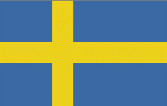
Description of flag: The flag of Sweden was adopted on Jun 22, 1906. It has a blue background with a yellow Scandinavian cross.
National Holiday: Flag Day, 6 June
Other Holidays: New Years' Day (January 1), Epiphany Day (January 6), Good Friday, May Day (May 1), Ascension Day (May 29), Sweden's National Day (June 6), Midsummer's Eve, Christmas (December 25)
The People of Sweden
Languages Spoken: Swedish, small Sami- and Finnish-speaking minorities
Nationality: Swede(s)
Religions: Lutheran 87%, Roman Catholic, Orthodox, Baptist, Muslim, Jewish, Buddhist
Origin of the name Sweden: The name "Sweden" comes from an old English word meaning "people of the Swedes." The Swedish word for the country is "Sverige" which means "Kingdom of the Swedes."
Famous People:
- ABBA - Rock group
- Ingrid Bergman - Actress
- Bjorn Borg - Tennis player
- Ray Bradbury - Author who wrote Fahrenheit 451
- Anders Celsius - Scientist and astronomer, invented the Celsius temperature scale
- Charles XII - King of Sweden during the Great Northern War
- Greta Garbo - Actress
- Zlata Ibrahimovic - Soccer player
- Stieg Larsson - Author
- Astrid Lindgren - Author of children's books
- Henrik Lundqvist - Hockey player
- Alfred Nobel - Scientist who invented dynamite
- Ann-Margret - Actress
- Annika Sorenstam - Professional golfer
- Gustav Vasa - King of Sweden, founder of modern Sweden
Geography >> Europe >> Sweden History and Timeline
** Source for population (2019 est.) is United Nations. GDP (2011 est.) is CIA World Factbook.