|
The Science of the Cell for Kids |
|
The cell is the basic unit of life. Some organisms are made up of a single cell, like bacteria, while others are made up of trillions of cells. We're made up of cells, too.
Different Types of Cells
Each cell is different and performs a different function. In the human body we have nerve cells which can be as long as from our feet to our spinal cord and help transport messages. We also have billions of tiny little brain cells and muscle cells which help us move around. There are many more cells in our body that help us to function and stay alive.
Although there are lots of different cells, most of them fit under two main types of cells:
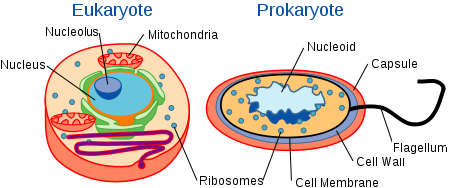
Prokaryotic Cells - The prokaryotic cell is a simple, small cell with no nucleus. Most bacteria are prokaryotic. There are three main parts to the prokaryotic cell: 1) the outside or cell wall 2) the flagella which is like an appendage and can help the cell to move 3) The inside or cytoplasm.
Eukaryotic Cells - these cells are a lot bigger and have a cell nucleus which houses the cell's DNA. These are the types of cells we find in plants and animals.
Parts of the Cell
There are a lot of parts and functions to some cells. Here are some of the man components many cells have:
- Membrane - This is the outer boundary of the cell. Sort of like the skin. It allows some substance in and keeps others out.
- Mitochondria - This is where the cell gets its energy. In the human body food we have digested and oxygen react here to make energy for the cell.
- Ribosomes - Ribosomes make stuff the cells needs, like proteins.
- Nucleus - The nucleus is the brains of the cell. It uses chromosomes to instruct the rest of the cell what to do next.
- Cytoplasm - This is the stuff that fills up the rest of the cell. The other components of the cell float around in the cytoplasm. It's mostly water.
- Lysosomes - These guys clean up the place getting rid of waste and other unwanted substances that may get into the cell.
The machines inside the cell like the nucleus, ribosomes, and lysosomes are called organelles.
Fun Facts About Cells
- They were discovered by scientist Robert Hooke.
- The largest known cells are ostrich eggs. They can weigh over three pounds.
- When many cells of the same kind are together in a group, it's call tissue.
- The word cell comes from the Latin word cellula, which means small room.
- Humans actually carry more bacteria cells than human cells. Yuck!
More biology subjects:
The Cell
Bacteria
Photosynthesis
Trees
Animals
Scientific Classification
Nutrition
Vitamins and Minerals
Back to Kids Science
Page
Back to Kids Study
Page
Back to Ducksters Kids Home
Page
|
|
Kid's Poll |
|
Which of these cities would you most like to visit on vacation?
|
|
Joke of the Day |
Q: Knock, knock----Who's There?----Ashe----Ashe who?
A: Bless you!
|
|
Today In History |
|
Who was born on this day: 1952 Mr. T (Actor) 1981 Josh Hamilton (Baseball player) What happened today in history:
1881 The American Red Cross is established by Clara Barton. 1927 Charles Lindbergh completes the first solo nonstop flight across the Atlantic Ocean.
|
|