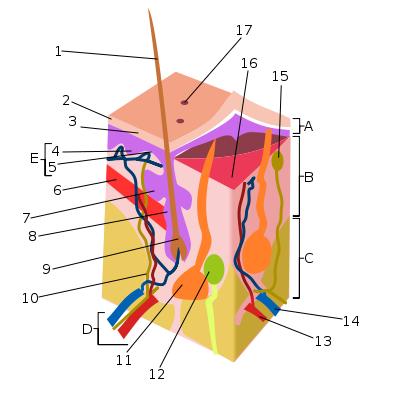
We all have skin. It covers our entire body and keeps the good stuff in and the bad stuff out. But what exactly is skin? We'll get into the details below, but for starters the skin is an organ. Just like the heart or the brain. It's an important organ that performs many functions to enable us to live. Functions of the skin The skin is multipurpose, meaning it has a lot of functions. It's our first line of protection against the outside environment, it houses one of our five senses, it absorbs sunlight for vitamin D and heat, and regulates our internal temperature. Protection One of the basic functions of the skin is protection. Over the majority of your body the skin is around 2mm thick. In some areas, like your eyelids, it's thinner, while in other areas, like the soles of your feet, it's much thicker. The skin helps to keep bad stuff out of our body, like germs and dirt that can cause infection. It also keeps good stuff in, like fluids such as water and blood. Sense of Touch The skin also houses one of our five senses: touch. In our skin are thousands and thousands of sensors or receptor cells. These sensors send information to the brain about things we touch. They can tell the brain if it's hot, cold, rough, smooth, or painful. Different areas of our body have more receptor cells than others. Our hands, feet, and lips all have extra receptors making those areas even more sensitive. There are actually different types of receptor cells for each type of sensation. Temperature Control: The skin plays a large role in regulating our body's temperature. When we get too hot it sweats to help cool us off. It can also widen the skin's blood vessels to get more blood near the skin where it can cool off. At the same time the skin can narrow the blood vessels to help us warm up. By controlling blood flow and sweat, the skin regulates our body temperature. Layers of the skin The skin has three primary layers. Each one has it's function.
Experiment: Skin Temperature - How does our skin lower or raise our temperature? More on the Human Body: Brain Nervous System Digestive System Sight and the Eye Hearing and the Ear Smelling and Tasting Skin Muscles Breathing Blood and Heart Bones List of Human Bones Back to Kids Science Page Back to Kids Study Page Back to Ducksters Kids Home Page |
|