Sports Study Music Kids Site and Search Games Movies Fun Kids

The Science of Sight and the Eye for Kids

Sight is one of the five senses that help us to get information about what is going on in the world around us. We see through our eyes, which are organs that take in light and images and turn them into electrical impulses that our brain can understand.

How do we see?

When we see something, what we are seeing is actually reflected light. Light rays bounce off of objects and into our eyes.

Our Amazing Eyeballs

Pupil and Iris:

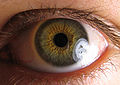
Eyes are amazing and complex organs. In order for us to see light enters our eyes through the black spot in the middle which is really a hole in the eye called the pupil. The pupil can change sizes with the help of the colored part around it, a muscle called the iris. By opening and closing the pupil, the iris can control the amount of light that enters the eye. If the light is too bright, the pupil will shrink to let in less light and protect the eye. If it's dark, the iris will open the pupil up so more light can get into the eye.


Retina:

Once the light is in our eye it passes through fluids and lands on the retina at the back of the eye. The retina turns the light rays into signals that our brain can understand. The retina uses light sensitive cells calls rods and cones to see. The rods are extra sensitive to light and help us to see when it's dark. The cones help us to see color. There are three types of cones each helping us to see a different color of light: red, green, and blue.

Focus:

In order for the light to be focused on the retina, our eyes have a lens. The brain sends feedback signals to the muscles around the lens to tell it how to focus the light. Just like a camera or microscope works when we adjust the lens to get the image to focus. When the lens and muscles can't quite focus the light just right, we end up needed glasses or contacts to help our eyes out.

Off to the Brain:

The rods and cones of the retina change light into electrical signals for our brain. The optic nerve takes these signals to the brain. The brain also helps to control the eye to help it focus and to control where you are looking. Both eyes move together with speed and precision to allow us to see with the help of the brain.

Why two eyeballs?

With two eyeballs our brain gets two slightly different pictures from different angles. Although we only "see" one image, the brain uses these two images to give us information on how far away something is. This is called depth perception.

Fun facts about the eye
  • The image at the retina is actually upside down from the actual image. Our brain figures this out for us and switches it around, or we would get really confused!
  • The cornea is a clear layer at the front of the eye that helps protect it.
  • We have a blind spot where the optical nerve connects to the retina.
  • Tears help keep the eye clean, but scientist don't really understand why we cry when we are sad or upset.
  • The average person blinks 15 times per minute.
  • Around eight percent of men are color blind, but less than one percent of women.


More on the Human Body:
Brain
Nervous System
Digestive System
Sight and the Eye
Hearing and the Ear
Smelling and Tasting
Skin
Muscles
Breathing
Blood and Heart
Bones
List of Human Bones

Back to Kids Science Page

Back to Kids Study Page

Back to Ducksters Kids Home Page

Kid's Poll

Which of these cities would you most like to visit on vacation?
New York City
Paris
London
Tokyo
Rome


Vote on more Kids Polls!


Joke of the Day

Q: Knock, knock----Who's There?----Ashe----Ashe who?

A: Bless you!


Today In History

Who was born on this day:
1952 Mr. T (Actor)
1981 Josh Hamilton (Baseball player)

What happened today in history:
1881 The American Red Cross is established by Clara Barton.
1927 Charles Lindbergh completes the first solo nonstop flight across the Atlantic Ocean.