The Battles of Lexington and Concord signaled the start of the American Revolutionary war on April 19, 1775. The British Army set out from Boston to capture rebel leaders Samuel Adams and John Hancock in Lexington as well as to destroy the Americans store of weapons and ammunition in Concord. The colonists were warned however, by riders including Paul Revere, that the British Army was approaching. Sam Adams and John Hancock were able to escape and the local militia was able to hide much of their ammunition and weapons.
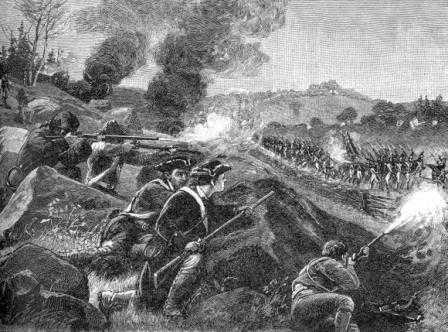
Battle of Lexington Engraving by Unknown
Battle of Lexington
The Battle of Lexington was a very small fight. You could hardly call it a battle, but it's important because it's where the Revolutionary War started. When the British arrived, there were only around 80 American militiamen in the town. They were led by Captain John Parker. They were up against a much larger British force led by Major John Pitcairn. Neither side expected to actually fight, but in the midst of the confusion a gunshot went off forcing the British to attack. Some of the colonists were killed and the rest fled.
The gunshot was the first shot of the American Revolution and the start of the war. It was called the "shot heard around the world" by Ralph Waldo Emerson in his poem Concord Hymn. No one is actually sure who fired the first shot or if it was an American or British soldier.
Battle of Concord
After the Americans fled from Lexington, the British marched to the city of Concord. When they first got to Concord, they met little resistance and began to search the town for the militia's hidden stash of weapons and munitions. The Americans had retreated to the outskirts of Concord and observed the British from other side of the North Bridge. As the Americans waited, more and more local militiamen arrived making their forces stronger and stronger.
The Americans decided to cross the North Bridge back into Concord. They defeated the British troops at the North Bridge, giving the Americans renewed confidence. Soon the British commander, Colonel Francis Smith, realized that the American militia resistance was rapidly growing and it was time to retreat.
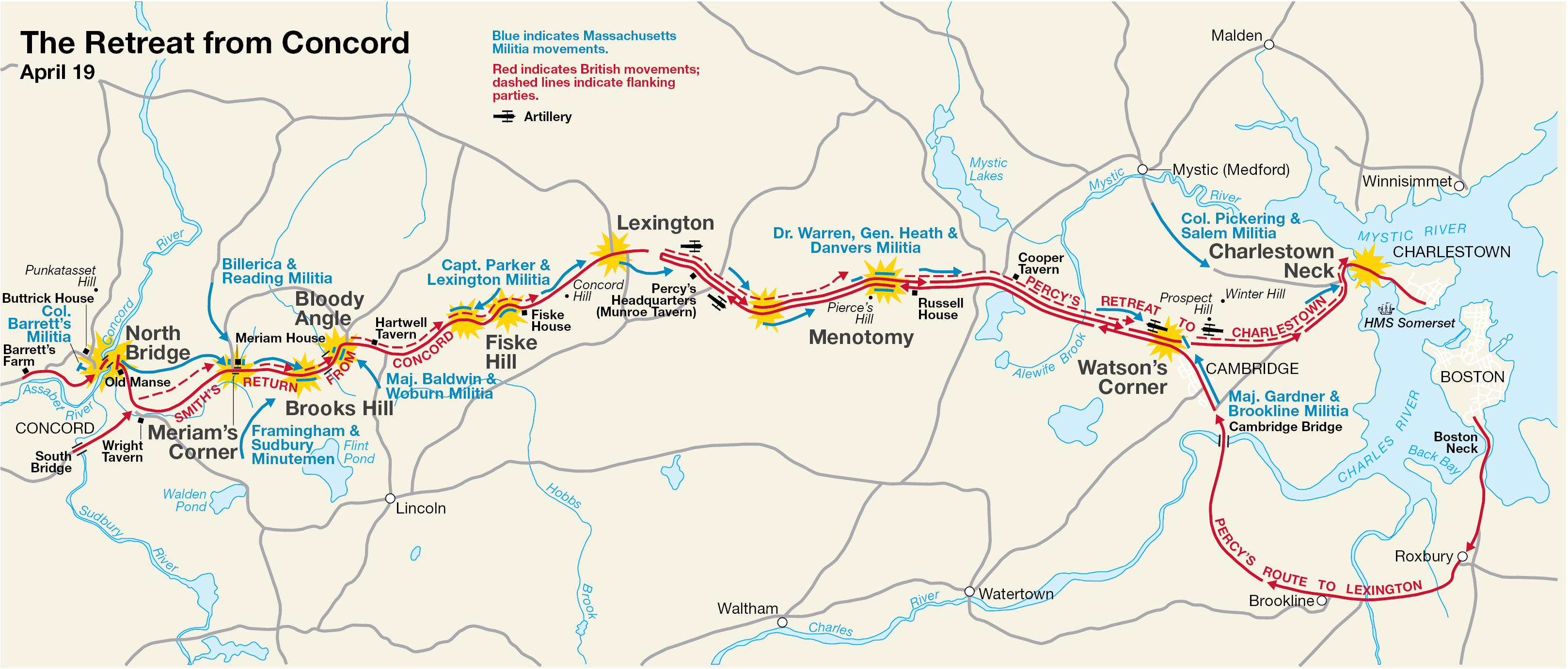
British retreat from Concord - click for larger view
Source: National Park Service
The British Retreat
Once the British decided to retreat, they began the long march back to the city of Boston. The Americans continued to gain forces and continued to attack and harass the British during their retreat. By the time the British reached Boston they had lost 73 men and 174 were wounded. The Americans lost 49 men and 41 were wounded.
With these battles, the American Revolution had officially begun. Shots had been fired, thousands of militiamen surrounded Boston, and the Americans felt they had pushed back the British giving them the courage to continue to unite and fight.
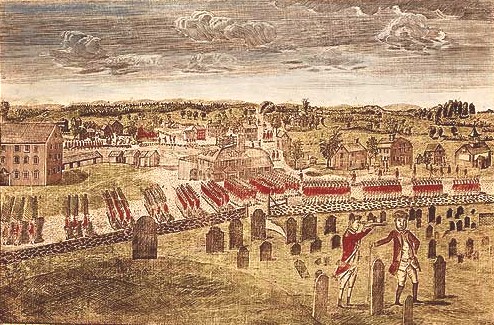
Declaration of Independence by Amos Doolittle
Interesting Facts about the Battles of Lexington and Concord
The British were led by Lieutenant Colonel Francis Smith. There were 700 British regulars.
The British soldiers were called "regulars" or sometimes red coats because they wore red uniforms.
The leader of the militiamen in Lexington was Captain John Parker. A lot of his soldiers, around 25% of them, were his relatives.
Some of the American militia were called minutemen. This meant they were ready to fight with just a minute's notice.
Around 15,000 militiamen surrounded Boston the day after these two battles occurred.