a2 + b2 = c2
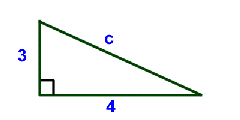
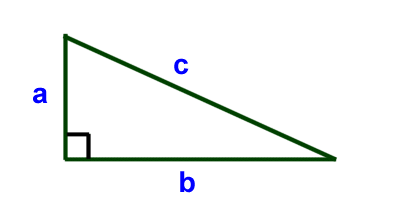
Where a, b, and c are the lengths of the sides of the triangle (see the picture) and c is the side opposite the right angle. In this example, c is also called the hypotenuse. Let's work through a few examples: 1) Solve for c in the triangle below: In this example a = 3 and b=4. Let's plug those into the Pythagorean Formula.
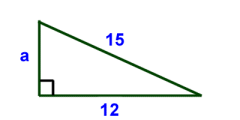
2) Solve for a in the triangle below: In this example b=12 and c= 15
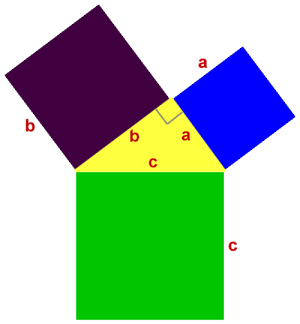
The Pythagorean Theorem itself The theorem is named for a Greek mathematician named Pythagoras. He came up with the theory that helped to produce this formula. The formula is very useful in solving all sorts of problems. Here is what the theorem says: In any right triangle, the area of the square whose side is the hypotenuse (remember this is the side opposite the right angle) is equal to the sum of the areas of the squares whose sides are the two legs (the two sides that meet at a right angle). This may not make a lot of sense when you first read it. Let's show more what the formula does and what the words say in a picture. If you take each side of the yellow triangle and use it to make a square (see the picture below). Then you get these three squares. The area of each square is width x height. So in this example the area of each square is a2, b2, and c2.
What the theorem says is that the area of the purple square plus the area of the blue square will equal the area of the green square. That's the same as saying: a2 + b2 = c2 Advanced Kids Math Subjects Statistics Mean, Median, Mode, and Range Picture Graphs Algebra Order of Operations Exponents Ratios Ratios, Fractions, and Percentages Geometry Polygons Quadrilaterals Triangles Pythagorean Theorem Circle Perimeter Surface Area Misc Prime Numbers Roman Numerals Back to Kids Math Back to Kids Study |

|