John Quincy Adams
was the 6th President of the United States.
Served as President: 1825-1829 Vice President: John Caldwell Calhoun Party: Democratic-Republican Age at inauguration: 57
Born: July 11, 1767 in Braintree, Massachusetts Died: February 23, 1848 in Washington D.C., after collapsing on the floor of the House two days earlier.
Married: Louisa Catherine Johnson Adams Children: George, John, Charles Nickname: Old Man Eloquent
Biography:
What is John Quincy Adams most known for?
John Quincy Adams was son of Founding Father and 2nd President of the United States John Adams. He was known as much for his government service before and after being president as when he was president.
Growing Up
Adams grew up during the time of the American Revolution. He even observed part of the Battle of Bunker Hill from a distance when he was a child. When his father became ambassador to France and later the Netherlands, John Quincy traveled with him. John learned much about European culture and languages from his travels, becoming fluent in both French and Dutch.
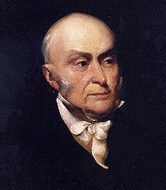
John Quincy Adams by T. Sully
Adams returned to the United States after the war and enrolled in Harvard University. He graduated in 1787 and became a lawyer in Boston.
Before He Became President
Due to his father's influence, Adams soon became involved in government service. He worked in some capacity with each of the first five presidents. He began his political career as U.S. ambassador to the Netherlands under George Washington. He worked as ambassador to Prussia under his father John Adams. For President James Madison he worked as ambassador to Russia and, later, the United Kingdom. While Thomas Jefferson was president, Adams served as the Senator from Massachusetts. Finally, under James Monroe he was Secretary of State.
Secretary of State
Adams is considered one of the great Secretaries of State in the history of the United States. He was able to gain the territory of Florida from Spain for $5 million. He also was the main author of the Monroe Doctrine. An important part of U.S. policy that stated the U.S. would defend countries in North and South America from being attacked by European powers. He also helped to negotiate the joint occupation of the Oregon country with Great Britain.
Presidential Election
In the early days of the United States, the Secretary of State was generally considered the next in line for the presidency. Adams ran against war hero Andrew Jackson and Congressman Henry Clay. He received fewer votes than Andrew Jackson in the general election. However, since no candidate received a majority of votes, the House of Representatives had to vote on who would be president. Adams won the vote in the House, but many people were angry and said he won due to corruption.
John Quincy Adams' Presidency
Adams' presidency was somewhat uneventful. He tried to get a law passed to raise tariffs and help American businesses, but the Southern states were against it. The law never passed. He also tried to set up a national transportation system of roads and canals. However, this too failed in congress.
After Being President
A few years after being president, Adams was elected to the U.S. House of Representatives. He is the only president to be elected to the House of Representatives after being president. He served in the House for 18 years, fighting hard against slavery. He first argued against the "gag" rule, which said slavery could not be discussed in congress. After getting the "gag" rule repealed, he began to argue against slavery.
How did he die?
Adams suffered a massive stroke while at the House of Representatives. He died in a nearby cloakroom in the Capitol building.
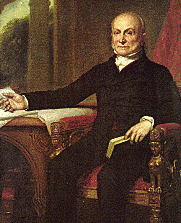
John Quincy Adams by George P.A. Healy
Fun Facts About John Quincy Adams
He predicted that if a Civil War broke out the president could use his war powers to abolish slavery. This is exactly what Abraham Lincoln did with the Emancipation Proclamation.
He began writing a journal in 1779. By the time he died, he had written fifty volumes. Many historians cite his journals as first hand accounts of the formation of the early United States.
Adams was quiet, liked to read, and may have suffered from depression.
He married his wife, Louisa, in London, England.
The election campaigns between Adams and Andrew Jackson were particularly ugly. Adams refused to attend Jackson's inauguration and was one of only three presidents to not attend the inauguration of his successor.
Adams was a major proponent of the advancement of science. He saw science as important to the future of the United States.