James Monroe was the 5th President of the United States.
Served as President: 1817-1825 Vice President: Daniel D. Tompkins Party: Democratic-Republican Age at inauguration: 58
Born: April 28th, 1758 in Westmoreland County, Virginia Died: July 4, 1831 in New York, New York
Married: Elizabeth Kortright Monroe Children: Eliza and Maria Nickname: Era of Good Feelings President
Biography:
What is James Monroe most known for?
James Monroe is most famous for the Monroe Doctrine. This was a bold statement that told the European countries that the United States would not stand for further intervention or colonization in the Americas.
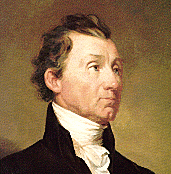
James Monroe by John Vanderlyn
Growing Up
James grew up in the Virginia colony at the time when tensions were mounting between the American colonies and their British rulers. His father was a farmer and a carpenter. When he was just sixteen years old his father died and James was expected to take over his father's estate and take care of his four younger brothers and sisters. Fortunately, James was a bright and capable young man.
James enrolled in the College of William and Mary, but his education was cut short when the Revolutionary War broke out. He joined the local Virginia Militia and then the Continental Army. Soon he held the rank of Major and fought under the command of George Washington. At the battle of Trenton he was shot in the shoulder, but recovered that winter at Valley Forge.
Before He Became President
Monroe left the army a dedicated war hero and decided to become a lawyer. He learned the law by working for Thomas Jefferson's law practice. He later went into politics where he was very successful. First he became a member of the Virginia legislature and then a delegate to the Continental Congress. After the United States was formed as a new country, he became a member of the US congress and then Governor of Virginia.
Monroe also gained experience by working for several presidents. He went to France for Thomas Jefferson to help with buying the Louisiana Purchase, which doubled the size of the United States. He also served as Secretary of State and Secretary of War for President James Madison.
James Monroe's Presidency
During Monroe's presidency five new states were admitted into the country. These included Mississippi, Illinois, Alabama, Maine, and Missouri. Monroe also further added to the expansion of the United States by buying the territory of Florida from Spain.
The Missouri Compromise
When Missouri was admitted to the United States there was a controversy over whether slavery would be allowed within the state. The southern states wanted slavery to be permitted in Missouri, while the northern states wanted it to be a free state. After much arguing they came up with a compromise called the Missouri Compromise. Missouri would be admitted as a slave state and Maine as a free state.
The Monroe Doctrine
In 1823, Monroe decided that the US would no longer allow European countries to colonize or conquer independent states in the Americas. This included South America as well, where many countries had just gained independence from Spain. He made a US policy that stated that if a European country were to attack or colonize any country in the Americas, the United States would consider it an act of war. This policy later became known as the Monroe Doctrine.
How did he die?
After his wife passed, Monroe moved in with his daughter's family in New York. He quickly fell ill and died on the 4th of July, exactly five years after Thomas Jefferson and John Adams died.
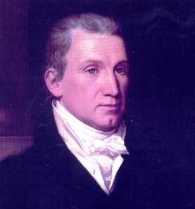
James Monroe by Gilbert Stuart
Fun Facts about James Monroe
He was the third president to die on the 4th of July.
In the famous painting of George Washington Crossing the Delaware, the soldier holding the flag is supposed to be Monroe.
Secretary of State John Quincy Adams actually wrote the Monroe Doctrine.
He was a descendent of Edward III the King of England.
His daughter Maria was married in the White House. This was the first wedding at the White House.
He was the last president who was an adult during the Revolutionary War. He is considered the last of the Founding Fathers to become president.