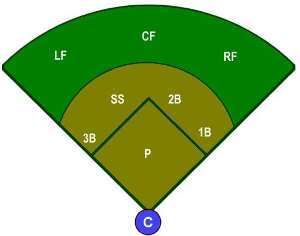
The catcher is a position in baseball that plays behind home plate. The catcher has many responsibilities and is part of the "battery" with the pitcher. The main job of the catcher is to catch pitches and to help call the game. The catcher is one of the most important players on defense as they are involved in every play.
Catching a Pitch
As the name of the position implies, the main job of the catcher is to catch the pitch. Many catchers are experts at catching the pitch so that it is more likely to be called for a strike. Here are some catching tips:
Don't reach for the ball, let it come to you.
Keep your hands soft, but your arm and wrist firm.
If the pitch is in the strike zone, keep your mitt as still as possible. Don't drop your mitt, especially if the pitch is low.
Move your glove to the spot before the ball gets there. This way you can hold the mitt still which can help get a strike called.
Keep your glove up and in the location where the pitch should be in order to give the pitcher a good target.
Young catchers may want to try keeping the glove low. It is easier to reach up for a high pitch than down for a low pitch.
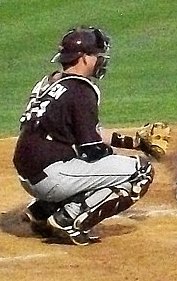
Catcher's Stance
Author: Brandonrush, CC0
Catcher's Stance
The catcher's stance is crouched down with your feet about shoulder width. Your throwing arm should be behind your back so it doesn't get hit by the ball. If there are no players on base and less than two strikes, you can use a relaxed stance. When there are players on base, you need to be in a ready stance. In the ready stance you should be balanced on the balls of your feet, prepared to make a play or throw at any moment.
Blocking Pitches
Having a good catcher that can block wild pitches is one of the most important jobs of the catcher in youth leagues. In the case of a pitch in the dirt, the most important thing is to stop the ball from getting past you, not catching the ball. The following steps are how you can prevent the ball from getting past you:
Move in front of the ball. As soon as you see the pitch is going to be wild, get in front of the ball.
Drop to your knees.
Put your mitt between your legs.
Lean forward to keep the ball from bouncing too far away after it rebounds.
Calling the Game
This may not be as important in youth baseball as in the major leagues, but catchers signal to the pitcher what type of pitch to make. In the end, the pitcher makes the final decision, but a good catcher can help to make suggestions based on the current batter.
Throwing
Catchers must have a strong throwing arm. They need to be able to catch a pitch, rise quickly, and make a strong throw to second base or third. This is to keep base runners from stealing a base.