Distance from the Sun: 8th planet from the sun, 2.8 billion miles (4.5 billion km)
Type of Planet: Ice Giant (gas surface with an interior composed of ices and rock)
What is Neptune like?
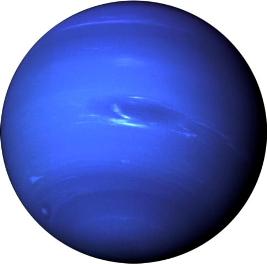
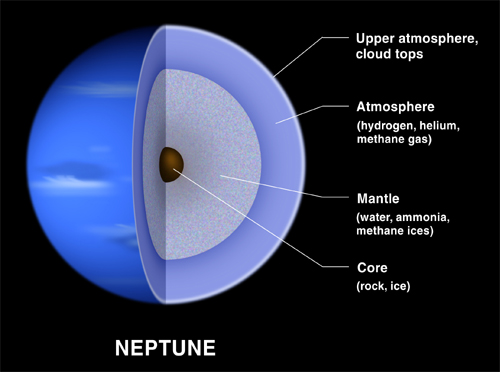
Neptune is the eighth and furthest planet from the sun. Neptune's atmosphere gives it a blue color which is fitting with it being named after the Roman god of the sea. Neptune is an ice giant planet. This means it has a gas surface like the gas giant planets, but it has an interior composed mostly of ices and rock. Neptune is slightly smaller than its sister planet Uranus making it the 4th largest planet. However, Neptune is a little bit larger in mass than Uranus making it the 3rd largest planet by mass.
Internal structure of Neptune. Source: NASA.
The Atmosphere of Neptune
Neptune's atmosphere is mostly made up of hydrogen with a smaller amount of helium. The surface of Neptune swirls with huge storms and powerful winds. One large storm was photographed by Voyager 2 when it passed by Neptune in 1989. It was called the Great Dark Spot. The storm was as big as the size of the Earth!
The Moons of Neptune
Neptune has 14 known moons. The largest of Neptune's moons is Triton. Neptune also has a small ring system similar to Saturn, but not nearly as large or as visible.
How does Neptune compare to Earth?
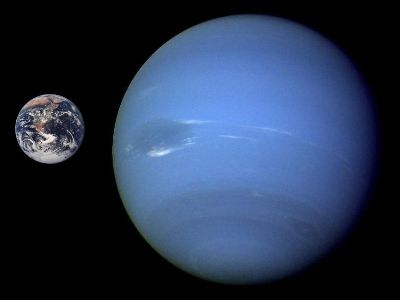
Since Neptune is a gas giant planet, there is no rocky surface to walk around on like Earth. Also, Neptune is so far away from the Sun that, unlike Earth, it gets most of its energy from its inner core rather than from the Sun. Neptune is much, much bigger than earth. Even though much of Neptune is gas, its mass is 17 times that of Earth's.
Neptune is much larger than Earth. Source: NASA.
How do we know about Neptune?
Neptune was first discovered by mathematics. When astronomers found that the planet Uranus did not follow their predicted orbit around the sun, they figured out that there must be another planet that was pulling on Uranus with gravity. They used some more mathematics and found out where Neptune should be. In 1846, they were finally able to see Neptune through a telescope and verify their mathematics.
The only space probe to visit Neptune was Voyager 2 in 1989. By using the close up pictures from Voyager 2, scientists were able to learn a lot about Neptune.
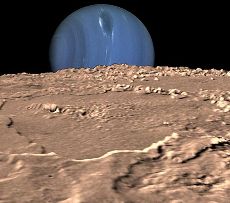
Neptune viewed over the horizon of the moon Triton. Source: NASA.
Fun Facts about the Planet Neptune
There is still a controversy over who discovered Neptune.
It is the coldest planet in the Solar System.
The largest moon, Triton, orbits Neptune backwards from the rest of the moons. This is called a retrograde orbit.
Despite its huge size, the gravity on Neptune is similar to that on Earth.
It was the first planet found by mathematical prediction.