Distance from the Sun: 5th planet from the sun, 484 million miles (778 million km)
Type of Planet: Gas Giant (composed mostly of hydrogen and helium)
What is Jupiter like?
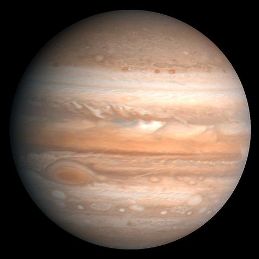
Jupiter is the largest planet in the Solar System and is the fifth planet from the sun. It is more than 300 times more massive than Earth and is more than two times as massive than all the other planets combined. Jupiter is called a gas giant planet. This is because its surface is made up of a thick layer of hydrogen gas. Deep within the planet, under the gas, the pressure becomes so intense that the hydrogen turns into liquid and then finally into a metal. Under the Hydrogen is a rocky core that is about the size of planet Earth.
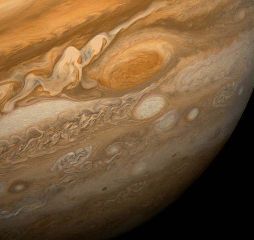
The Great Red Spot storm on Jupiter. Source: NASA.
Weather on Jupiter
Jupiter's surface is very violent with massive hurricane-like storms, winds, thunder and lightning. One storm on Jupiter, called the Great Red Spot, is three times the size of earth. The Great Red Spot has been storming for hundreds of years. The energy powering Jupiter's storms isn't from the sun, but is from radiation generated by Jupiter itself.
The Moons of Jupiter
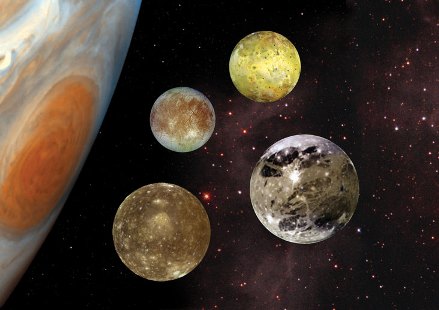
Jupiter is home to a number of interesting moons including Ganymede, Io, Europa, and Callisto. These four moons were first discovered by Galileo and are called the Galilean Moons. Ganymede, the largest moon in the Solar System, is larger than the planet Mercury. Io is covered in volcanoes and lava. Europa, on the other hand, is covered in ice and has a huge salt water sea underneath the ice. Some think there is a good possibility that life may exist in the seas of Europa. The many varying moons around Jupiter make it a fascinating place to explore.
Galilean moons of Jupiter including Io, Europa, Ganymede, and Callisto. Source: NASA.
How does Jupiter compare to Earth?
Jupiter is wildly different from Earth. First off, there is no place to stand, the surface is gas. Second, Jupiter is 300 times the size of earth and has (at least) 79 moons vs. Earth's one moon. Also, Jupiter has a 300 year-old storm that would swallow up the Earth without even noticing it. I'm glad we don't have any storms like that!
How do we know about Jupiter?
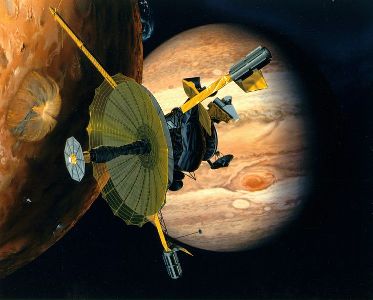
Being the 3rd brightest object in the night sky, humans have known of Jupiter's existence for thousands of years. Galileo first discovered Jupiter's 4 largest moons in 1610 and others claim to have discovered the Great Red Spot not long after. In 1973 the space probe Pioneer 10 flew by Jupiter and provided the first close up pictures of the planet. The Pioneer probes were followed by Voyager 1 and 2 which gave us the first close up shots of Jupiter's moons. Since then there have been many more fly-bys of Jupiter. The only spacecraft to orbit Jupiter was the Galileo in 1995.
The Galileo mission to Jupiter. Drawing of the probe near the moon Io. Source: NASA.
Fun Facts about the Planet Jupiter
In Roman mythology, Jupiter was king of the gods and god of the sky. He was the equivalent of the Greek god Zeus.
It is the fastest spinning planet in the Solar System.
Jupiter has three very faint rings.
It has an extremely strong magnetic field that is 14 times stronger than the magnetic field of the Earth.
Viewed from the Earth, it is the third brightest object in the night sky.