Guilds in the Middle Ages were associations or groups of craftsmen. Each guild focused on a specific trade such as the candlemaker's guild or the tanner's guild.
Why were guilds important?
Guilds in the Middle Ages played an important role in society. They provided a way for trade skills to be learned and passed down from generation to generation. Members of a guild had the opportunity to rise in society through hard work.
The guild protected members in many ways. Members were supported by the guild if they came onto hard times or were sick. They controlled working conditions and hours of work. The guild also prevented non-guild members from selling competitive products. Some guild members were even exempt from paying high taxes from the lords and kings.
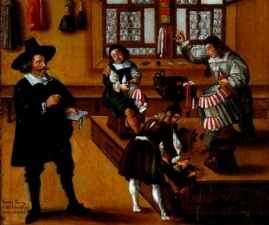
Merchant Guild from the Master Panel of Ulmer Schneider 1662
Guilds helped more than just their members. They had numerous rules that helped to keep the quality of work and pricing consistent. This helped consumers to know they were getting a good product at the correct price.
Guild Positions
In each guild in the Middle Ages there were very well defined positions of Apprentice, Journeyman, and Master. Apprentices usually were boys in their teens who signed up with a master for around 7 years. They would work hard for the master during this time in exchange for learning the craft plus food, clothing, and shelter.
Once the apprenticeship was complete, he became a Journeyman. As a Journeyman, he would still work for a master, but would earn wages for his work.
The highest position of the craft was the Master. To become a Master, a Journeyman would
need the approval of the guild. He would have to prove his skill, plus play the politics needed to
get approval. Once a Master, he could open his own shop and train apprentices.
Types of Guilds
In a major city during the Middle Ages, there could be as many as 100 different guilds. Examples include weavers, dyers, armorers, bookbinders, painters, masons, bakers, leatherworkers, embroiderers, cobblers (shoemakers), and candlemakers. These were called craft guilds.
There also were merchant guilds. Merchant guilds controlled the way trade was handled in the town. They could become very powerful and controlled much of the local economy.
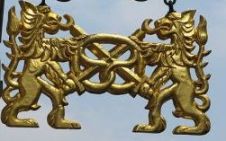
A guild sign by Abubiju via Wikimedia Commons
Interesting Facts about the Guilds
Powerful guilds had their own hall in town where they would hold courts to settle member disputes and hand out punishment to those who broke the rules.
Even though many women during the Middle Ages learned skilled crafts, they were not allowed to join a guild or form their own guild.
The word "guild" comes from the words tribute or payment, which the members had to pay to guild.
A Journeyman had to produce a "masterpiece" to be approved by the guild masters.