Geography >> Europe >> Greece History and Timeline
Greece
Capital: Athens
Population: 10,473,455
The Geography of Greece
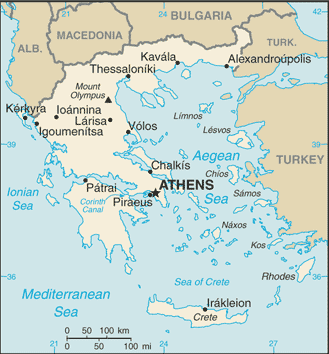
Borders: Albania, Macedonia, Bulgaria, Turkey, Mediterranean Sea
Total Size: 131,940 square km
Size Comparison: slightly smaller than Alabama
Geographical Coordinates: 39 00 N, 22 00 E
World Region or Continent: Europe
General Terrain: mostly mountains with ranges extending into the sea as peninsulas or chains of islands
Geographical Low Point: Mediterranean Sea 0 m
Geographical High Point: Mount Olympus 2,917 m
Climate: temperate; mild, wet winters; hot, dry summers
Major Cities: ATHENS (capital) 3.252 million; Thessaloniki 834,000 (2009), Patras
Major Landforms: Over 200 inhabited islands including Crete, Euboea, Rhodes, and Lesbos. Aegean Islands, Argo-Saronic Islands, Peloponnese peninsula, Mount Olympus, Pindus Mountain Range, Vikos Gorge, Rhodope Range
Major Bodies of Water: Aliakmonas River, Achelous River, Evros River, Lake Volvi, Lake Trihonida, the Prespa Lakes, Ionian Sea, Aegean Sea, Sea of Crete, Mediterranean Sea

Meteora
Economy of Greece
Major Industries: tourism, food and tobacco processing, textiles, chemicals, metal products; mining, petroleum
Agricultural Products: wheat, corn, barley, sugar beets, olives, tomatoes, wine, tobacco, potatoes; beef, dairy products
Natural Resources: lignite, petroleum, iron ore, bauxite, lead, zinc, nickel, magnesite, marble, salt, hydropower potential
Major Exports: food and beverages, manufactured goods, petroleum products, chemicals, textiles
Major Imports: machinery, transport equipment, fuels, chemicals
Currency: euro (EUR)
National GDP: $293,900,000,000
Government of Greece
Type of Government: parliamentary republic
Independence: 1829 (from the Ottoman Empire)
Divisions: Greece is divided up into thirteen regions (Attica, Central Greece, Central Macedonia, Crete, East Macedonia and Thrace, Epirus, Ionian Islands, North Aegean, Peloponnese, South Aegean, Thessaly, West Greece, West Macedonia) and one autonomous state (Mount Athos).
National Anthem or Song: Ymnos eis tin Eleftherian (Hymn to Liberty)
National Symbols:
- Animal - Dolphin
- Tree - Olive Tree
- Flower - Laurel branch, violet
- Motto - Freedom or death
- Colors - Blue and white
- Greek Coat of Arms - A white cross on a blue shield surrounded by a circle of blue and white laurel branches.
- Food - Feta, Greek salad, olive oil
- Other symbols - Phoenix (mythical), double-headed eagle, Vergina Sun, the goddess Athena, the owl
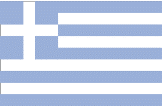
Description of flag: The Greek flag was adopted on December 22, 1978. It has nine horizontal stripes of alternating blue and white with five blue and four white stripes. In the upper left is a white cross with a blue background. It is sometimes referred to as "I Galanolefki" or the "Blue and White". The cross represents Eastern Orthodox Christianity. The nine stripes are said to represent the nine Muses from Greek Mythology or the number of syllables in the Greek motto. The blue and white colors represent the Greek sea, sky, and clouds.
National Holiday: Independence Day, 25 March (1821)
Other Holidays: New Years' Day (January 1), Epiphany (January 6), Independence Day (March 25), Good Friday, Easter, Labor Day (May 1), Whit Monday, Assumption (August 15), Ochi Day (October 28), Christmas (December 25)
The People of Greece
Languages Spoken: Greek 99% (official), English, French
Nationality: Greek(s)
Religions: Greek Orthodox 98%, Muslim 1.3%, other 0.7%
Origin of the name Greece: The name "Greece" comes from the Latin term "Graecia" which was used by the Romans. It means "land of the Greeks." However, the Greek people refer to the country as Hellas and the official name for the country is the Hellenic Republic.

Aristotle and Plato
- Alexander the Great - World leader
- Aristotle - Philosopher and scientist
- Maria Callas - Opera singer
- El Greco - Artist
- Homer - Epic poet who wrote the Iliad and the Odyssey
- Pericles - Leader of Athens
- Andreas Papandreou - Politician
- Aristotle Onassis - Businessman
- Plato - Philosopher
- Pythagoras - Mathematician and scientist
- Georgios Samaras - Soccer player
- Pete Sampras - Tennis player
- Socrates - Philosopher
- Sophocles - Playwright
Geography >> Europe >> Greece History and Timeline
** Source for population (2019 est.) is United Nations. GDP (2011 est.) is CIA World Factbook.