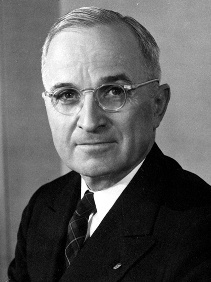
Harry S. Truman by United States Army Signal Corps
Harry S. Truman
was the 33rd President of the United States.
Served as President: 1945-1953 Vice President: Alben William Barkley Party: Democrat Age at inauguration: 60
Born: May 8, 1884 in Lamar, Missouri Died: December 26, 1972 in Independence, Missouri
Married: Elizabeth Virginia Wallace Truman Children: Margaret Nickname: Give 'Em Hell Harry
Biography:
What is Harry S. Truman most known for?
Harry S. Truman became president when Franklin D. Roosevelt died. He is most known for putting an end to World War II in the Pacific by dropping the atomic bomb on Japan. He is also known for the Marshall Plan, the Truman Doctrine, and the Korean War.
Growing Up
Harry grew up on a farm in Missouri. His family was poor and Harry had to work hard at chores to help out around the farm. He enjoyed music and reading as a child. Every morning he would get up early to practice the piano. His parents didn't have the money to send him to college, so Harry went to work after high school. He worked a number of different jobs including a railroad timekeeper, a bookkeeper, and a farmer.
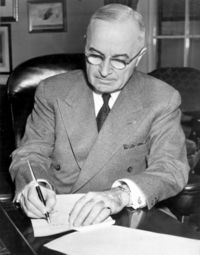
Truman initiating Korean involvement by Unknown
Before He Became President
In World War I Truman served as an artillery captain in France. Upon returning home, he opened a clothing store, but it failed. Truman then entered politics where he was much more successful. He worked as a judge for many years and then won a seat on the U.S. Senate in 1935. He was a senator for ten years when FDR asked him to run as Vice President in 1944.
Harry S. Truman's Presidency
President Roosevelt died shortly after being elected for his fourth term and Truman became president. World War II was still raging at the time, but things were looking up for the Allies. Just a few months later the Germans surrendered, but President Truman still had to deal with the Japanese.
The Atomic Bomb
The Japanese had all but been defeated in World War II, except they were refusing to surrender. An invasion of Japan would likely cost hundreds of thousands of American lives. At the same time the United States had just developed a horrible new weapon, the atomic bomb. Truman had to decide whether to invade or use the bomb. In an effort to save the lives of U.S. soldiers he decided to use the bomb.
The United States dropped an atomic bomb on Hiroshima, Japan on August 6, 1945. A few days later they dropped another on Nagasaki. The devastation of these cities was unlike anything ever seen. The Japanese surrendered shortly after.
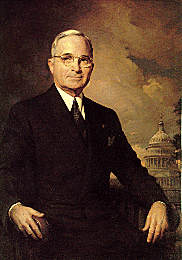
Harry Truman by Greta Kempton
International Issues
After World War II there were still many issues that Truman had to deal with. First was the reconstruction of Europe, which was ravaged by the war. He used the Marshall Plan to help European nations rebuild.
Another major post-war issue was the Soviet Union and communism. The Soviet Union had become a major power and wanted to spread communism throughout the world. Truman helped to form the North Atlantic Treaty Organization (NATO) with Canada and Western Europe. These countries would help to protect each other from the Soviet Union. This also started the Cold War between the U.S. and the Soviet Union.
With the spread of communism, wars began to break out in other areas of the world. Truman sent U.S. troops to Korea to fight in the Korean War. He also sent aid to Vietnam.
How did he die?
Truman lived a long life after leaving the presidency. He died of pneumonia at the age of 88.
Fun Facts about Harry S. Truman
Harry was named after his uncle Harrison.
The "S" does not stand for anything. It comes from his grandfathers' names.
He was the only president in the 1900s who did not attend college.
His wife, Bess Truman, lived to the age of 97.
The 1948 election against Thomas Dewey was very close. Many people were sure he would lose. One paper, the Chicago Tribune was so sure that their headline read "Dewey Defeats Truman". Truman won, however. Oops!