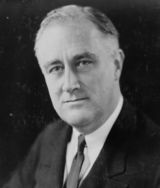
Franklin Delano Roosevelt from the Library of Congress
Franklin D. Roosevelt
was the 32nd President of the United States.
Served as President: 1933-1945 Vice President: John Nance Garner, Henry Agard Wallace, Harry S. Truman Party: Democrat Age at inauguration: 51
Born: January 30, 1882 in Hyde Park, New York Died: April 12, 1945 in Warm Springs, Georgia
Married: Anna Eleanor Roosevelt Children: Anna, James, Elliot, Franklin, John, and a son who died young Nickname: FDR
Biography:
What is Franklin D. Roosevelt most known for?
President Roosevelt is most known for leading the United States and the Allied Powers against the Axis Powers of Germany and Japan during World War II. He also led the country during the Great Depression and instituted the New Deal which included programs such as Social Security and the Federal Deposit Insurance Corporation (FDIC).
Roosevelt was elected to president for four terms. This is two more terms than any other president.
Growing Up
Franklin grew up in a wealthy and influential New York family. He was tutored at home and traveled the world with his family during his childhood. He graduated from Harvard in 1904 and married his distant cousin Anna Eleanor Roosevelt. He then went to Columbia Law School and began to practice law.
Roosevelt became active in politics in 1910 when he was elected to the New York State Senate and, later, the Assistant Secretary of the Navy. However, his career stopped for a while in 1921 when he became sick with polio. Although he survived his bout with polio, he nearly lost the use of his legs. For the rest of his life he could only walk a few short steps by himself.
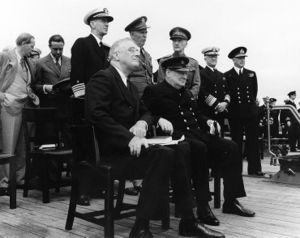
Roosevelt and Churchill on the Prince of Wales from the US Navy
Before He Became President
Franklin's wife Eleanor told her husband not to give up. So, despite his condition, he continued with both his law and political career. In 1929 he was elected Governor of New York and, after serving two terms as governor, he decided to run for president in the 1932 election.
Franklin D. Roosevelt's Presidency
In 1932 the country was in the midst of the Great Depression. People were looking for some new ideas, leadership, and hope. They elected Franklin Roosevelt hoping he had the answers.
The New Deal
When Roosevelt entered office as president the first thing he did was to sign a number of new bills into laws in an effort to fight the Great Depression. These new laws included programs such as Social Security to help retirees, the FDIC to help secure bank deposits, work programs such as the Civilian Conservation Corps, new power plants, aid for farmers, and laws to improve working conditions. Finally, he established the SEC (Security and Exchange Commission) to help regulate the stock market and hopefully prevent any future collapses in the financial markets.
All of these programs together were called the New Deal. In his first 100 days of being president, Roosevelt signed 14 new bills into law. This time became known as Roosevelt's Hundred Days.
World War II
In 1940 Roosevelt was elected to his third term as president. World War II had broken out in Europe and Roosevelt promised that he would do what he could to keep the U.S. out of the war. However, on December 7, 1941 Japan bombed the U.S. Naval base at Pearl Harbor. Roosevelt had no choice but to declare war.
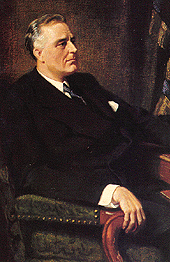
Franklin Delano Roosevelt by Frank O. Salisbury
Roosevelt worked closely with the Allied Powers to help fight back against Germany and Japan. He partnered with Winston Churchill of Great Britain as well as Joseph Stalin of the Soviet Union. He also laid the groundwork for future peace by coming up with the concept of the United Nations.
How did he die?
As the war was coming to an end, Roosevelt's health began to fail. He was posing for a portrait when he had a fatal stroke. His last words were "I have a terrible headache." Roosevelt is considered by many to be one of the greatest presidents in the history of the United States. He is remembered with a National Memorial in Washington D.C.
He met President Grover Cleveland when he was five years old. Cleveland said "I am making a wish for you. It is that you may never become president of the United States."
After Roosevelt's presidency, a law was made that allowed presidents to serve a maximum of two terms. Prior to Roosevelt, previous presidents had followed George Washington's example of only serving two terms despite there being no law against serving more.
He was the first president to appear on television during a 1939 broadcast from the World's Fair.
During World War II, Roosevelt spoke to the American people over the radio in a series of talks called the "fireside chats."
One of his famous quotes is "The only thing we have to fear is fear itself."