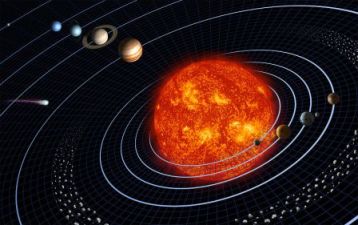
Gravity is the mysterious force that makes everything fall down towards the Earth. But what is it? It turns out that all objects have gravity. Every object in the world pulls all the other objects towards itself. It's just that some objects, like the Earth, have a lot more gravity than others. How much gravity an object has depends on how big it is. To be specific, how much mass it has. It also depends on how close you are to the object. The closer you are, the stronger the gravity. Why is gravity important? Gravity is very important to our everyday lives. Without Earth's gravity we would fly right off it. We'd all have to be strapped down. If you kicked a ball, it would be fly off forever. While it might be fun to try for a few minutes, we certainly couldn't live without gravity. ![]() Gravity also is important on a larger scale. It's the Sun's gravity that keeps the Earth in orbit around the Sun. Life on Earth needs the Sun's light and warmth to survive. The planets themselves rely on gravity when they were formed and to stay together. Who discovered gravity? The first person who dropped something heavy on their toe knew something was going on, but gravity was first mathematically described by the scientist Isaac Newton. His theory is called Newton's law of universal gravitation. Later Albert Einstein would make some improvements on this theory in his Theory of Relativity. What is weight? Weight is the force of gravity on an object. Our weight on Earth is how much force the Earth's gravity has on us and how hard it is pulling us toward the surface. Do objects fall at the same speed? Yes, this is called the equivalence principle. Objects of different masses will fall to the Earth at the same speed. If you take two balls of different masses to the top of a building and drop them, they will hit the ground at the same time. There is actually a specific acceleration that all objects fall at called a standard gravity, or "g". It equals 9.807 m/s2. Fun facts about gravity
The Atom Energy Friction Gravity Heat Laws of Motion Light Light Spectrum Simple Machines Sound 101 Sound 102 Back to Kids Science Page Back to Kids Study Page |
|