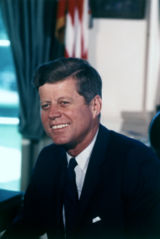
John grew up in a wealthy and powerful political family in Brookline, Massachusetts. It was also a big family as he had three brothers and five sisters. John's father Joe had the dream that one of his sons would become president. He sent them to the best schools and expected that his oldest son, Joe Jr., would be president one day.
John graduated from Harvard in 1940 with honors. He then traveled to Great Britain to be with his father who was the U.S. Ambassador to Great Britain at the time. Here he learned firsthand about World War II and realized that the U.S. would likely be involved before it was over. He tried to join the army, but couldn't get in because he had a bad back. So he joined the Navy and was in command of a patrol torpedo boat when it was sunk. He survived and became something of a war hero. Sadly, his older brother Joe wasn't as lucky and died in combat during the war.
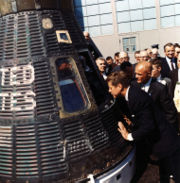
JFK inspects Mercury capsule by Cecil Stoughton, White House
Before He Became President
When Joe Jr. died, John's father turned to John to become president. He got John involved in politics and helped John to get elected to the U.S. Congress in 1947. John served as congressman for six years and then became a U.S. Senator in 1953.
Kennedy ran for president in 1960 against current Vice President Richard Nixon. He won in one of the closest elections in history.
John F. Kennedy's Presidency
When Kennedy was elected he gave one of the most stirring inaugural speeches in history. In this speech he said the famous words "Ask not what your country can do for you - ask what you can do for your country." His presidency was marked by major events in the Cold War. These events included the building of the Berlin Wall in Germany by the communists, the Bay of Pigs, and the Cuban Missile Crisis.
Bay of Pigs
Just a few months after becoming president, Kennedy decided to try and help Cuban rebels overthrow the communist Cuban leader Fidel Castro. Unfortunately, the invasion failed miserably when the CIA-assisted rebels were soundly defeated. This event is called the Bay of Pigs because of the name of the bay where the invasion took place.
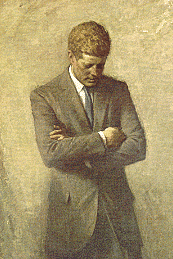
John F. Kennedy by Aaron Shikler
Cuban Missile Crisis
In 1962 the United States discovered that the Soviet Union was building secret missile bases in Cuba. These missiles would be able to strike the U.S. with nuclear bombs. In the coming days the U.S. and the Soviet Union came close to nuclear war. The U.S. quarantined Cuba in order to keep the missiles out. After negotiations, the Soviet Union agreed to dismantle the bases. In return, the U.S. agreed to never attack Cuba and to remove missiles from Turkey.
How did he die?
On November 22, 1963 John F. Kennedy was shot by Lee Harvey Oswald while riding in a convertible car in Dallas, Texas.
Fun Facts about John F. Kennedy
He was the first president who was a Boy Scout.
He was the youngest ever to be elected president (Teddy Roosevelt was the youngest president, but he came into office due to the death of President McKinley).
His grandfather, John Fitzgerald, was mayor of Boston and a U.S. Congressman.
He won the Pulitzer Prize in history for the book Profiles in Courage.
Bobby Kennedy, John's younger brother, was one of his key advisors and headed up the Justice Department while John was president. Bobby later ran for president, but was assassinated before the election.