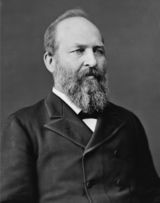
James Garfield is most known for being assassinated only 200 days after becoming president. He was killed by a former supporter who was angry that Garfield didn't give him a job in his administration.
Growing Up
James Garfield grew up as the youngest of four children in a log cabin in Ohio. His father died when he was still a toddler. His mother raised him and taught him to read at home. James had long dreamt of a life at sea and as a teenager he set out to find his dream. He worked for a short time on a canal boat, but ended up returning home to continue his education.
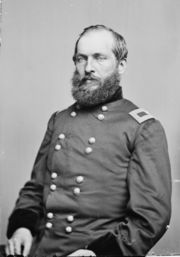
James A. Garfield by Matthew Brady
In 1856 James graduated from the Western Reserve Eclectic Institute. After graduation he became a professor at the school. James then began to study law and in 1860 passed the bar so he could be a lawyer.
When the Civil War began Garfield joined the army. He rose in the ranks to the point of major general. He served as the Chief of Staff to William Rosecrans as well. During this time he fought in the battles of Middle Creek, Shiloh and Chickamauga. While serving in the army he was elected to the U.S. Congress.
Before He Became President
Initially Garfield wanted to stay part of the army. However, President Lincoln asked him to come to Washington. Lincoln felt that having Garfield as a strong Republican ally in the Congress would be more valuable to him than as a general. Garfield agreed to take the position in Congress where he served on the U.S. House of Representatives for eighteen years. He became one of the leaders of the Republican side of the House.
James A. Garfield's Presidency
Although Garfield was president for only a short time before he was assassinated, he managed to make a mark while president. He was adamant that political corruption come to an end. He refused to give supporters jobs within his administration just because they had supported his campaign. He thought jobs should go to those most qualified.
Garfield also refused to give in to the Senate over political appointments. Two senators even resigned over the issue, thinking they would make Garfield look bad and they would get their jobs back. Garfield stood firm, though, and ended up getting his way in the end.
How did he die?
On July 2, 1881 Garfield was shot by assassin Charles J. Guiteau while walking through a train station. Guiteau was upset that he had not received the job as consul to Paris. Garfield died a few months later from complications of the bullet wound.
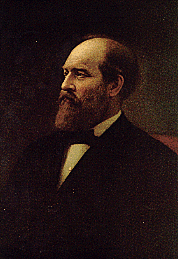
James A. Garfield by Calvin Curtis
Fun Facts About James A. Garfield
Because of Garfield's powerful voice and his ability at public speaking, he became known as the Preacher President.
Garfield taught himself to write with both hands. He also knew Latin and Greek. He sometimes would show off and write with both hands at the same time, each in a different language!
Alexander Graham Bell, the inventor of the telephone, tried to help locate the bullet lodged within Garfield with a metal detector he had invented. Unfortunately, he was unsuccessful.
When he was shot, Garfield exclaimed "My God, what is this?"
He won the presidency over Democrat Winfield Hancock by the slim margin of 10,000 popular votes.
There were seven presidents born in a log cabin. He was the last of the log cabin presidents.
There were three presidents in the year 1881: Hayes, Garfield, and Arthur.
He was the first president whose mother attended his inauguration.