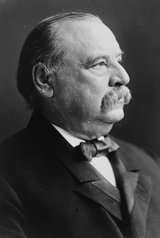
Grover Cleveland
was the 22nd and 24th President of the United States.
Served as President: 1885-1889 and 1893-1897 Vice President: Thomas Andrews Hendricks, Adlai Ewing Stevenson Party: Democrat Age at inauguration: 47, 55
Born: March 18, 1837 in Caldwell, New Jersey Died: June 24, 1908 in his home in Princeton, New Jersey
Married: Frances Folsom Cleveland Children: Ruth, Esther, Marion, Richard, Frances Nickname: Uncle Jumbo, The Beast of Buffalo
Biography:
What is Grover Cleveland most known for?
Grover Cleveland is most famous for being the first president to serve two non-consecutive terms. This means he was president for one term (four years), lost the next election (to Benjamin Harrison), then came back to win again in the following election.
Growing Up
Grover was born in New Jersey, but spent much of his childhood growing up in New York. He was the son of a minister and the fifth child in a large family of nine children. His father died when he was a teenager and Grover had to quit school to help support his family. He only had around four years of formal education and learned to read and write at home.
A few years after his father died, Grover decided to move out west. On the way, he stopped off at an uncle's house in Buffalo, New York and ended up staying there. His uncle got him a job clerking for a lawyer. Grover worked hard and studied law. In 1859 he passed the bar and became a lawyer himself.
Before He Became President
Grover Cleveland ran a successful law practice for many years. In 1870 he started his political career getting elected sheriff of Erie County. He became known as an honest man who didn't play the games of machine politics. This made him popular with the voters. In just a few years, Cleveland was elected Mayor of Buffalo and then to Governor of New York. He continued to be open during this time, making sure that government contracts were open bid and not given to political friends.
Cleveland's reputation as a political reformer earned him the Democratic nomination for president in the 1884 election. He was up against James Blaine who was thought to be a corrupt politician. The Democrats saw this as their opportunity to win the presidency back. Cleveland won in a close election and became president of the United States.
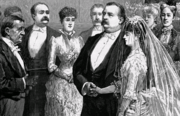
Grover Cleveland's wedding by T. de Thulstrup
Grover Cleveland's Presidency
In an effort to clean up the government, Cleveland vetoed much of the legislation that passed over his desk. He vetoed more than twice as many laws as all the previous presidents before him. He became known as the "Veto President" (this was also President Andrew Johnson's nickname).
1888 Election and Between Terms
In the 1888 election Cleveland lost to Benjamin Harrison. The race was very close as he actually won the popular vote, but lost the electoral vote. When moving out of the White House, it is said that Frances Cleveland told the White House staff she would be returning in four years. She was right as Cleveland would be re-elected president four years later.
Grover returned to his law practice over the next four years. He also prepared for his comeback as he ran again in 1892, winning back the White House. He became the only president to serve non-consecutive terms of office.
Second Term
One year into Cleveland's second term, things went bad in the economy. The Panic of 1893 happened causing many banks to fail and economic depression. It was the worst depression in the history of the United States up to that point. The only time worse in the history of the U.S. would be the Great Depression in 1929.
Cleveland was unsure what to do to lift the country out of depression. The country did not recover while he was president and he was not nominated again in the next election.
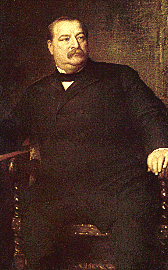
Grover Cleveland by Eastman Johnson
How did he die?
Grover Cleveland died of a heart attack around eleven years after leaving the White House. His last words were "I have tried so hard to do right."
Fun Facts About Grover Cleveland
Rather than fight in the Civil War, he paid a man $150 to fight in his place. This was common in those days.
When he was sheriff, Cleveland was also the town executioner and ended up having to personally hang murderers.
His slogan for government reform was "public office is a public trust."
Cleveland married 21 year old Frances Folsom while he was president. He was the only president to be married in the White House.
The Baby Ruth candy bar was named after Cleveland's daughter Ruth and not after the famous baseball player Babe Ruth.