|
Nigeria
|

|
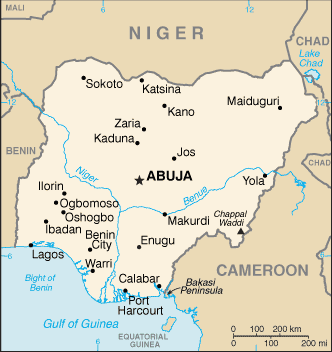
Capital: Abuja
Population: 200,963,599
Brief History of Nigeria:
Over history several kingdoms and societies have developed in the land of Nigeria. To the north were the Hausa kingdoms and the Bornu Empire. In the south the Yoruba kingdom of the Oyo developed around 1400. The Oyo expanded over the next several centuries to cover much of the southwest area. In the 15th and 16th centuries the kingdom of Benin developed in the south central part of Nigeria.
Starting in the 17th century, European traders began to establish coastal ports for trading with the local peoples. At first the primary export was slaves, but this was replaced with palm oil and timber once slavery was abolished by the British. In the 19th century, Fulani leader Usman dan Fodio brought most of northern Nigeria under the control of his empire and converted many to the religion of Islam.
In 1914 Nigeria became a British colony. It would stay a British colony until 1960 when it became an independent country. Much of its history since has been marked with military rule.
The Geography of Nigeria
Total Size: 923,768 square km
Size Comparison: slightly more than twice the size of California
Geographical Coordinates: 10 00 N, 8 00 E
World Region or Continent: Africa
General Terrain: southern lowlands merge into central hills and plateaus; mountains in southeast, plains in north
Geographical Low Point: Atlantic Ocean 0 m
Geographical High Point: Chappal Waddi 2,419 m
Climate: varies; equatorial in south, tropical in center, arid in north
Major cities: Lagos 10.203 million; Kano 3.304 million; Ibadan 2.762 million; ABUJA (capital) 1.857 million; Kaduna 1.519 million (2009)
The People of Nigeria
Type of Government: federal republic
Languages Spoken: English (official), Hausa, Yoruba, Igbo (Ibo), Fulani
Independence: 1 October 1960 (from UK)
National Holiday: Independence Day (National Day), 1 October (1960)
Nationality: Nigerian(s)
Religions: Muslim 50%, Christian 40%, indigenous beliefs 10%
National Symbol: eagle
National Anthem or Song: Arise Oh Compatriots, Nigeria's Call Obey
Economy of Nigeria
Major Industries: crude oil, coal, tin, columbite; palm oil, peanuts, cotton, rubber, wood; hides and skins, textiles, cement and other construction materials, food products, footwear, chemicals, fertilizer, printing, ceramics, steel, small commercial ship construction and repair
Agricultural Products: cocoa, peanuts, palm oil, corn, rice, sorghum, millet, cassava (tapioca), yams, rubber; cattle, sheep, goats, pigs; timber; fish
Natural Resources: natural gas, petroleum, tin, iron ore, coal, limestone, niobium, lead, zinc, arable land
Major Exports: petroleum and petroleum products 95%, cocoa, rubber
Major Imports: machinery, chemicals, transport equipment, manufactured goods, food and live animals
Currency: naira (NGN)
National GDP: $414,000,000,000
** Source for population (2012 est.) and GDP (2011 est.) is CIA World Factbook.
Back to Geography Home Page