|
Angola
|
|
Capital: Luanda
Population: 31,825,295
Brief History of Angola:
Angola was occupied by bushmen and tribes until it became part of the Kingdom of Kongo in the thirteenth century. Northern Angola was part of the Kingdom of Kongo while southern Angola become mostly under the rule of the Kingdom of Ndongo. They were ruled by a king called ngola.
In 1482 Diogo Cao and the Portuguese arrived in Angola. They began to trade with the King of Kongo and established a colony in 1575. Portugal gradually took over the area that is today Angola. They were mostly interested it the slave trade. They would purchase slaves from the local chiefs and kings and then sell them to Brazil and the Americas. Angola became one of the largest suppliers of slaves in Africa.
In the 1960's many rebel groups formed to try and get better conditions for the local Angolan's. There was much racism and not a lot of development in the country. Three main groups were formed: the MPLA (Popular Movement for the Liberation of Angola), the FNLA (National Front for the Liberation of Angola), and UNITA (National Union for the Total Independence of Angola). These groups fought back for independence and there was much civil war and conflicts in Angola for many years.
On November 11, 1975 Angola gained its independence. The three main groups (MPLA, FNLA, and UNITA) were put in charge, however they could not agree and all wanted power. Civil war broke out in Angola. The MPLA ruled for some time as a Marxist-communist government. There were elections in 1992, but not again until 2005. It is still a country torn by civil war and conflict.
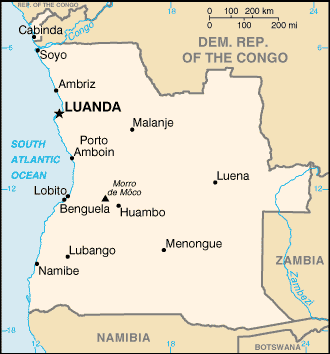
The Geography of Angola
Total Size: 1,246,700 square km
Size Comparison: slightly less than twice the size of Texas
Geographical Coordinates: 12 30 S, 18 30 E
World Region or Continent: Africa
General Terrain: narrow coastal plain rises abruptly to vast interior plateau
Geographical Low Point: Atlantic Ocean 0 m
Geographical High Point: Morro de Moco 2,620 m
Climate: semiarid in south and along coast to Luanda; north has cool, dry season (May to October) and hot, rainy season (November to April)
Major cities: LUANDA (capital) 4.511 million; Huambo 979,000 (2009), Cabinda
The People of Angola
Type of Government: republic; multiparty presidential regime
Languages Spoken: Portuguese (official), Bantu and other African languages
Independence: 11 November 1975 (from Portugal)
National Holiday: Independence Day, 11 November (1975)
Nationality: Angolan(s)
Religions: indigenous beliefs 47%, Roman Catholic 38%, Protestant 15% (1998 est.)
National Symbol: sable antelope
National Anthem or Song: Angola Avante (Forward Angola)
Economy of Angola
Major Industries: petroleum; diamonds, iron ore, phosphates, feldspar, bauxite, uranium, and gold; cement; basic metal products; fish processing; food processing, brewing, tobacco products, sugar; textiles; ship repair
Agricultural Products: bananas, sugarcane, coffee, sisal, corn, cotton, manioc (tapioca), tobacco, vegetables, plantains; livestock; forest products; fish
Natural Resources: petroleum, diamonds, iron ore, phosphates, copper, feldspar, gold, bauxite, uranium
Major Exports: crude oil, diamonds, refined petroleum products, gas, coffee, sisal, fish and fish products, timber, cotton
Major Imports: machinery and electrical equipment, vehicles and spare parts; medicines, food, textiles, military goods
Currency: kwanza (AOA)
National GDP: $116,300,000,000
** Source for population (2012 est.) and GDP (2011 est.) is CIA World Factbook.
Back to Geography Home Page