|
Yemen
|

|
Capital: Sanaa
Population: 29,161,922
Brief History of Yemen:
Yemen was a center of civilization as long as 3000 years ago. Kingdoms such as the Minaean, Sabaen, and the Himyarite controlled the spice trade from Yemen for hundreds of years. The area fell under the rule of the Ethiopian Empire and then later the Persian Empire.
In the 7th century, Islam moved into the area. The land was controlled by various Islamic leaders for many years after that. From the 16th to the 19th century the Ottoman Empire controlled Yemen.
In the 20th century Yemen was divided up into North and South Yemen. The South became a communist state in 1970. Hundreds of thousands of people fled from the South to the North an the countries battled for many years. In 1990 the two nations unified and became the Republic of Yemen.
The Geography of Yemen
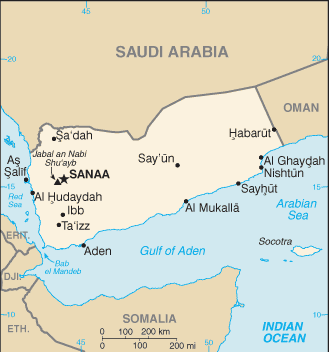
Total Size: 527,970 square km
Size Comparison: slightly larger than twice the size of Wyoming
Geographical Coordinates: 15 00 N, 48 00 E
World Region or Continent: Middle East
General Terrain: narrow coastal plain backed by flat-topped hills and rugged mountains; dissected upland desert plains in center slope into the desert interior of the Arabian Peninsula
Geographical Low Point: Arabian Sea 0 m
Geographical High Point: Jabal an Nabi Shu'ayb 3,760 m
Climate: mostly desert; hot and humid along west coast; temperate in western mountains affected by seasonal monsoon; extraordinarily hot, dry, harsh desert in east
Major cities: SANAA (capital) 2.229 million (2009)
The People of Yemen
Type of Government: republic
Languages Spoken: Arabic
Independence: 22 May 1990 (Republic of Yemen established with the merger of the Yemen Arab Republic [Yemen (Sanaa) or North Yemen] and the Marxist-dominated People's Democratic Republic of Yemen [Yemen (Aden) or South Yemen]); note - previously North Yemen had become independent in November of 1918 (from the Ottoman Empire) and South Yemen had become independent on 30 November 1967 (from the UK)
National Holiday: Unification Day, 22 May (1990)
Nationality: Yemeni(s)
Religions: Muslim including Shaf'i (Sunni) and Zaydi (Shi'a), small numbers of Jewish, Christian, and Hindu
National Symbol: golden eagle
National Anthem or Song: al-qumhuriyatu l-muttahida (United Republic)
Economy of Yemen
Major Industries: crude oil production and petroleum refining; small-scale production of cotton textiles and leather goods; food processing; handicrafts; small aluminum products factory; cement; commercial ship repair
Agricultural Products: grain, fruits, vegetables, pulses, qat, coffee, cotton; dairy products, livestock (sheep, goats, cattle, camels), poultry; fish
Natural Resources: petroleum, fish, rock salt, marble; small deposits of coal, gold, lead, nickel, and copper; fertile soil in west
Major Exports: crude oil, coffee, dried and salted fish
Major Imports: food and live animals, machinery and equipment, chemicals
Currency: Yemeni rial (YER)
National GDP: $57,970,000,000
** Source for population (2012 est.) and GDP (2011 est.) is CIA World Factbook.
Back to Geography Home Page