|
Luxembourg
|
|
Capital: Luxembourg
Population: 615,729
Brief History of Luxembourg:
Luxembourg was founded when the Count of Ardennes named Siegfried acquired Luxembourg Castle in 963. Around the castle a small town developed which grew into a small country. In the 1300s Luxembourg became a power in Europe. Three members of the House of Luxembourg were crowned as Holy Roman Emperors. In 1437, the House of Luxembourg ended because there was no male heir to take the throne. Over the next 400 years various European nations would control the small country.
On June 9, 1815 Luxembourg was given the status of Grand Duchy by the Congress of Vienna. The country was initially a neutral country, but after being occupied by Germany in both World Wars it joined NATO and then became one of the six original charter members of the European Union in 1951.
Today people in Luxembourg speak a variety of languages. The national language is Luxembourgish, which is a blend of Dutch, German, and French. However, French is used by the government, German is primarily used by the press, and many Luxembourgers learn English in school.
The Geography of Luxembourg
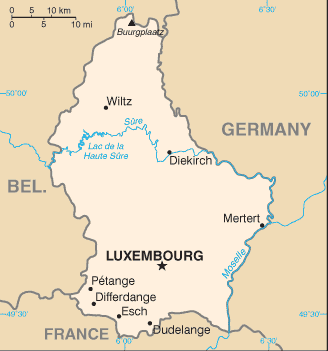
Total Size: 2,586 square km
Size Comparison: slightly smaller than Rhode Island
Geographical Coordinates: 49 45 N, 6 10 E
World Region or Continent: Europe
General Terrain: mostly gently rolling uplands with broad, shallow valleys; uplands to slightly mountainous in the north; steep slope down to Moselle flood plain in the southeast
Geographical Low Point: Moselle River 133 m
Geographical High Point: Buurgplaatz 559 m
Climate: modified continental with mild winters, cool summers
Major cities: LUXEMBOURG (capital) 90,000 (2009)
The People of Luxembourg
Type of Government: constitutional monarchy
Languages Spoken: Luxembourgish (national language), German (administrative language), French (administrative language)
Independence: 1839 (from the Netherlands)
National Holiday: National Day (Birthday of Grand Duchess Charlotte) 23 June
Nationality: Luxembourger(s)
Religions: 87% Roman Catholic, 13% Protestants, Jews, and Muslims (2000)
National Symbol: lion
National Anthem or Song: Ons Heemecht (Our Motherland); De Wilhelmus (The William)
Economy of Luxembourg
Major Industries: banking and financial services, iron and steel, information technology, telecommunications, cargo transportation, food processing, chemicals, metal products, engineering, tires, glass, aluminum, tourism
Agricultural Products: wine, grapes, barley, oats, potatoes, wheat, fruits; dairy products, livestock products
Natural Resources: iron ore (no longer exploited), arable land
Major Exports: machinery and equipment, steel products, chemicals, rubber products, glass
Major Imports: minerals, metals, foodstuffs, quality consumer goods
Currency: euro (EUR)
National GDP: $41,450,000,000
** Source for population (2012 est.) and GDP (2011 est.) is CIA World Factbook.
Back to Geography Home Page