|
Croatia
|
|
Capital: Zagreb
Population: 4,130,304
Brief History of Croatia:
The people of Croatia are called Croats. The first Croats settled in the area that is today called Croatia around 500 AD. They ruled themselves for many years, but decided to become part of the Hungarian Empire in 1091 through an agreement called the Pacta Conventa. When the Ottoman Empire began to expand in the 15th century, they became concerned they would be taken over by the Ottomans. So they asked Archduke Ferdinand if they could join the Austrian Habsburg Empire.
In 1868 Croatia again went under the rule of Hungary. This lasted until WWI when they became part of Yugoslavia. WWII brought terrible hardships on the country under German and Italian rule. When the war was over, Marshal Tito led the communist party to control over the country of Yugoslavia.
In the early 1990s, communism collapsed throughout eastern Europe. Yugoslavia became a place of much turmoil as different ethnic groups began to fight for power and independence. Croatia declared its independence from Yugoslavia and civil war erupted. War raged for many years between the Croatians and the Serbians. In December 1995, the Dayton peace agreement was signed bringing some peace to the area at last.
The Geography of Croatia
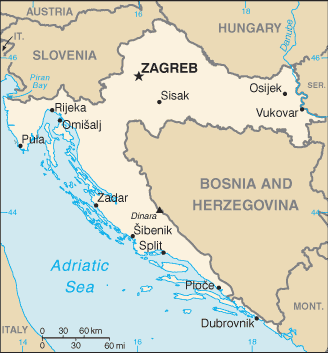
Total Size: 56,542 square km
Size Comparison: slightly smaller than West Virginia
Geographical Coordinates: 45 10 N, 15 30 E
World Region or Continent: Europe
General Terrain: geographically diverse; flat plains along Hungarian border, low mountains and highlands near Adriatic coastline and islands
Geographical Low Point: Adriatic Sea 0 m
Geographical High Point: Dinara 1,830 m
Climate: Mediterranean and continental; continental climate predominant with hot summers and cold winters; mild winters, dry summers along coast
Major cities: ZAGREB (capital) 685,000 (2009), Split, Rijeka
The People of Croatia
Type of Government: presidential/parliamentary democracy
Languages Spoken: Croatian 96.1%, Serbian 1%, other and undesignated 2.9% (including Italian, Hungarian, Czech, Slovak, and German) (2001 census)
Independence: 25 June 1991 (from Yugoslavia)
National Holiday: Independence Day, 8 October (1991); note - 25 June 1991 is the day the Croatian Parliament voted for independence; following a three-month moratorium to allow the European Community to solve the Yugoslav crisis peacefully, Parliament adopted a decision on 8 October 1991 to sever constitutional relations with Yugoslavia
Nationality: Croat(s), Croatian(s)
Religions: Roman Catholic 87.8%, Orthodox 4.4%, other Christian 0.4%, Muslim 1.3%, other and unspecified 0.9%, none 5.2% (2001 census)
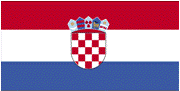
National Symbol: red-white checkerboard
National Anthem or Song: Lijepa nasa domovino (Our Beautiful Homeland)
Economy of Croatia
Major Industries: chemicals and plastics, machine tools, fabricated metal, electronics, pig iron and rolled steel products, aluminum, paper, wood products, construction materials, textiles, shipbuilding, petroleum and petroleum refining, food and beverages, tourism
Agricultural Products: wheat, corn, sugar beets, sunflower seed, barley, alfalfa, clover, olives, citrus, grapes, soybeans, potatoes; livestock, dairy products
Natural Resources: oil, some coal, bauxite, low-grade iron ore, calcium, gypsum, natural asphalt, silica, mica, clays, salt, hydropower
Major Exports: transport equipment, textiles, chemicals, foodstuffs, fuels
Major Imports: machinery, transport and electrical equipment; chemicals, fuels and lubricants; foodstuffs
Currency: kuna (HRK)
National GDP: $79,300,000,000
** Source for population (2012 est.) and GDP (2011 est.) is CIA World Factbook.
Back to Geography Home Page