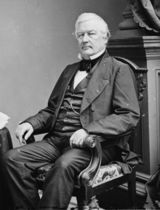
Millard Fillmore
was the 13th President of the United States.
Served as President: 1850-1853 Vice President: none Party: Whig Age at inauguration: 50
Born: January 7, 1800 in Cayuga County, New York Died: March 8, 1874 in Buffalo, NY
Married: Abigail Powers Fillmore Children: Millard, Mary Nickname: Last of the Whigs
Biography:
What is Millard Fillmore most known for?
Milliard Fillmore is most known for the Compromise of 1850 which tried to keep peace between the North and the South.
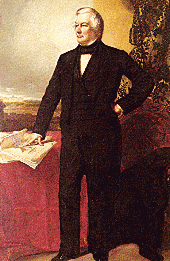
Millard Fillmore by G.P.A. Healy
Growing Up
Milliard Fillmore's life story is a classic American "rags to riches" tale. He was born into a poor family and raised in a log cabin in New York. He was the oldest son of nine children. Milliard had little formal education and was never able to attend college. However, he overcame his background and rose to the highest office in the country when he became president of the United States.
Milliard's first job was as an apprentice for a cloth maker, but he didn't like the work. Even though he wasn't able to get a formal education, he taught himself how to read and write. He also worked on improving his vocabulary. Eventually, he was able to get a job clerking for a judge. He took this opportunity to learn the law and by the age of 23 he had passed the bar exam and had opened his own law firm.
Before He Became President
Fillmore ran a very successful and prestigious law firm in New York. He first entered politics in 1828 when he won a seat on the New York State Assembly. In 1833 he ran for U.S. Congress. He served for four terms in the U.S. House of Representatives.
Vice President
Fillmore was nominated by the Whig Party to run as vice president with General Zachary Taylor in 1848. They won the election and Fillmore served as vice president up until Taylor's death in 1850, when he became president.
Millard Fillmore's Presidency
President Taylor and Milliard Fillmore had very different ideas about slavery and how the North vs. South issues should be handled. Taylor was adamant that the Union remain united. He even threatened the South with war. Fillmore, however, wanted peace above all else. He wanted to find a compromise.
The Compromise of 1850
In 1850, Fillmore signed a number of bills into law that became known as the Compromise of 1850. Some of the laws made the South happy while other laws made people in the North happy. These laws managed to make peace for a while, but it didn't last. Here are the five main bills:
California would be admitted as a free state. No slavery allowed.
The boundary of the state of Texas was settled and the state was paid for lost lands.
The area of New Mexico was given territorial status.
The Fugitive Slave Act - This said that slaves who escaped from one state to another would be returned to their owners. It even allowed for the use of federal officers to help.
The slave trade was abolished in the District of Columbia. Just the trade, however, slavery was still allowed.
Post Presidency
Fillmore was not elected to a second term as president. He wasn't even nominated by the Whig Party. Soon the Whig Party fell apart, earning Fillmore the nickname "Last of the Whigs". In 1856, he ran again for president and was nominated by the Know-Nothing Party. He came in a distant third place.
How did he die?
He died at home in 1874 from the effects of a stroke.
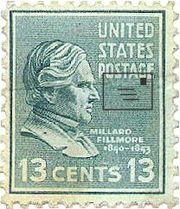
Millard Fillmore Stamp Source: US Post Office
Fun Facts About Millard Fillmore
He fell in love with and married his teacher, Abigail Powers.
Fillmore sent Commodore Matthew Perry to Japan to open trade. Although Perry didn't arrive until Franklin Pierce was president.
He protected the Hawaiian Islands from being taken over by France. When Napoleon III tried to annex the islands, Fillmore sent word that the U.S. would not allow it.
When he heard the Library of Congress was on fire, he ran down to help put it out.
He opposed President Abraham Lincoln during the Civil War.
Fillmore was one of the original founders of the University of New York at Buffalo.